Category: ORM

  • How an ORM Agency Can Help Protect and Enhance Your Online Reputation

    How an ORM Agency Can Help Protect and Enhance Your Online Reputation

    Your reputation is your best asset, for an individual or for a business. The question is how to grow and secure this asset at a time when negative reviews, ratings, or viral posts can damage it overnight. Brands are overwhelmingly turning to ORM agencies to create and maintain a halo of positive perception around their name, integrating online reputation management into their daily activities.

    What is Online Reputation Management or simply ORM?

    ORM is a broad term that aims to improve how the public sees a company, brand, or individual. Online reputation management involves a variety of activities, such as handling material, preventing and resolving problems that could harm a company’s overall market reputation, monitoring online reputation, and responding to customer complaints that damage their brand image.

    While a company’s reputation directly affects its market worth, ORM is essential to developing brand reliability. In a word, ORM assists firms in monitoring and upholding a favorable online reputation that boosts commercial profits.

    Why is it Critical for Businesses to Hire ORM Agencies?

    The majority of businesses struggle to maintain consumer loyalty. They continually work to create new features and products to fulfill their demands and have one-on-one interactions with them.

    But regardless of how much money businesses spend on customer support and product development, their reputation will occasionally suffer. Online reputation management begins to take effect whenever a dissatisfied client leaves a bad review or makes a vehement comment on social media.

    ORM companies can help you comprehend how customers view your company when they look for or encounter it online. To put it another way, they actively seek to understand what information users find online.

    This is crucial since 85% of consumers say they are as likely to believe internet evaluations from other customers as they are to believe personal recommendations from friends and family. Additionally, 49% of customers need at least a four-star rating from a company before they consider doing business with it.

    How ORM Functions

    The way your company is perceived online ultimately determines the chances of your success, whether your product and brand will be popular or you’ll have to struggle.

    ORM functions by circumventing the negative information with multiple types of positive content. For instance, the ORM agency might include more positive reviews if there were complaints about a product to guarantee that the reputation of the business as a whole was upheld.

    Another very effective strategy is to request pleased and satisfied customers for favorable reviews and a 5-star rating on Google. This affects a brand’s overall ranking.

    In addition, ORM services stress the use of both sponsored and earned media to disseminate material that further improves the brand reputation.

    What are the Concerns about your Reputation in the Digital Age?

    Now that you have some ideas about ORM and how it is used, let’s have a look at the concerns of having an online presence that must be handled professionally to save the reputation of your brand:

    1. Digital word-of-mouth.

    Most customers research products thoroughly before purchasing and are influenced by reviews and ratings as personal recommendations, which increases trust in a brand.

    However, many consumers would easily disregard five positive reviews but will change their minds if they encounter one negative review. Poor ratings are even more dangerous.

    2. You can’t delete a negative review.

    The best and worst thing about reviews and ratings is that they cannot be removed. You cannot erase reviews about your company, nor can you delete reviews about your competitors. You must guarantee that there are enough good reviews to balance out the negative ones and that your brand’s overall rating remains high.

    However, not every company considers negative feedback as an attack on their reputation; many use criticism from their customers to improve their services and product quality.

    Negative feedback can be very important in getting around the limitations and developing a fresh marketing approach.

    How the ORM Agencies Manage your Online Reputation

    Although many factors come into play, the final ORM strategy takes shape, based on the industry and its audiences. The following are some of the factors that ORM companies insist on helping secure a favourable online market reputation:

    • Having a sensible and interesting website—This helps you create your brand.
    • Having a web monitoring strategy that looks for negative reviews or comments about you online may include tools like Google Alerts. Other software can also be used for advanced filtering.
    • Social listening – this is the process of monitoring every mention of your name on social media using cutting-edge technology (AI-based tools) and social media experts. This technique can evaluate the worth of your brand while separating the unfavourable remarks and reviews to be handled professionally.
    • Using social media engineering – it may be possible to suppress embarrassing or insulting comments or negative press at the search engine level, if necessary. Otherwise, appropriate responses may be written back to reassure an unhappy customer. There are steps that may be performed to make sure that your public statement circumvents any negative news on Google when it is carried on the press channels. You can benefit from celebrity and influencer social media management as you work to establish your reputation.
    • Dealing with direct or indirect attacks – matured and professional responses to the issue should be posted. The goal would be to turn an adversary into an ally. Witty and modest responses backed by facts help win hearts. However, in some exceptional instances, proper legal action may be contemplated.

    Final Thoughts

    In the digital era, it’s absolutely important for corporations to manage their online reputation. Online reputation creates the right perception that you want your customers to have of you or your company, based on the reviews, comments, ratings, etc. that are publicly available metrics of online popularity.

    Employing a skilled OEM agency may prove to be essential for developing a positive internet reputation that will draw in new clients, increase trust and trustworthiness, and enhance your brand’s overall image.

    Source- Fluidscapes
    We are one of the best digital marketing companies in India that provides online reputation management services to all types of organizations. We assist businesses to stay on top of the game by leveraging the latest technologies and breakthroughs in marketing strategies and business processes. Want to grow your business, even more, get in touch with us and we’ll tell you how.
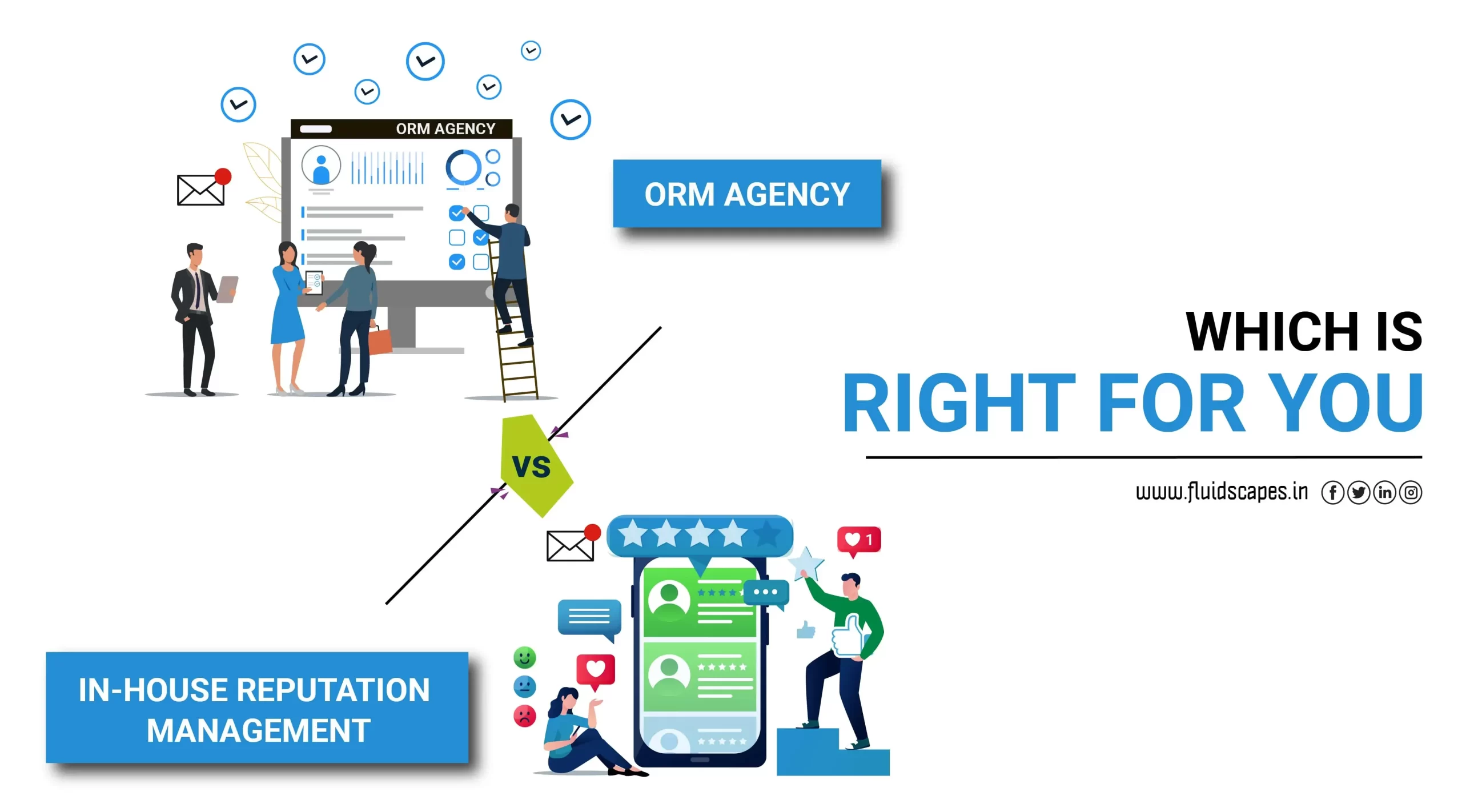
  • ORM Agency Vs. In-House Reputation Management: Which Is Right For You

    ORM Agency Vs. In-House Reputation Management: Which Is Right For You

    While ORM (Online Reputation Management) is seen as the backbone of a business’s branding strategy, the decision of whether it should be done in-house or through an ORM agency often requires deliberation. Each has its pros and cons, which must be weighed against the policy, budget, and goals of the business to select the right option.

    In order to ensure your ORM strategy delivers, it requires knowledge, skills, and dedication. So hiring the right team of professionals holds the key to expanding and growing your business through cut-throat competition.

    Sometimes this involves hiring talents to build your in-house team. However, outsourcing the operation to an external ORM agency may also look practical, considering many angles. As a result, small business owners frequently ponder, ‘Should I outsource or hire?’

    The answer isn’t easy, but there are a few essential factors to consider when deciding whether to hire someone full-time or use a third-party service provider. Continue reading for a guide on in-house versus outsourced recruiting so you can make an informed decision about when to outsource and when to maintain duties within your team.

    Considerations for an in-house team

    It is critical to recognize that the online marketplace is an open platform where the past and present experiences with respect to your brand are reflected, some of which could be engineered by the competitor brands. Therefore, having the right crew who will understand, manage, and take your brand ahead of the competition is the bedrock for in-house ORM exercise.

    The dilemma here is whether to select a group of individuals with extensive brand knowledge but no expertise in relationship management, or to select a group of individuals who are leaders in that field but have little to no brand expertise.

    Before selecting any of the above, there are a few questions you must understand and answer in order to make the best decision:

    1. Does your organisation have enough digital marketing specialists, in terms of content writers, influencers, researchers, analysts, domain experts, and so on?

    2. If so, do these resources have adequate time to devote to ORM implementation, or they have to perform other tasks as well.

    3. Do you have the right tools and competent analysts to monitor your and your competitors’ online performance (24/7)?

    4. Do you have the channel experts who can manage mentions of old issues or discrepancies.

    If you have the necessary setup that can meet the above requirements, you can begin your in-house ORM operation. Following are the benefits and drawbacks of running ORM in-house:

    Advantage:

    1. You are broadening the skillset of your company by gaining further experience.

    2. By utilising in-house manpower for the process, you reduce the chances of errors because they are more familiar with the product, brand and the corporate policies on various matters.

    3. The insights gathered through online reputation management are not shared and remain only within your organization. This is qualitative and quantitative data that is critical for developing future initiatives.

    Disadvantage:

    1. Industry knowledge is only one side of the coin; setting up ORM in-houses requires business process expertise, which needs to be built from scratch. Hence, it requires more time and devotion by the management for the project to kick off.

    2. Setting up an ORM team is equivalent to introducing a new department in an organization, hence the decision of making processes needs to come from the top management; which can be a big hurdle.

    3. The process might turn out to be more time as well as resource consuming than estimated, because ORM is not just about human resource management but also technical implementation. For example, if you are planning to implement ORM as one of the focus areas of your company, it would require integration of multiple fields. Your company’s knowledge base, customer information base, etc. needs to be integrated with the software tools being used for the ORM operation; and integration could be complicated and time consuming!

    4. In terms of cost-effectiveness, outsourcing is more efficient, because ORM agencies can take care of all the overhead processes related to training and maintaining the project, which gets tedious in-house.

    5. It also runs the risk of earning huge losses, due to latency or lethargy in the process, as well as due to lack of proper planning.

    Considerations for ORM agency

    If your organisation lacks the necessary software tools and skills, it is better to outsource the job. Managing a brand online is a time-consuming effort, and doing so with absolute skill is essential. An external ORM company has a variety of expertise dealing with other clients, which can be utilized in reputation building for your brand. Let’s look at the advantages and disadvantages of outsourcing ORM.

    Advantages:

    1. The external ORM agency, if selected properly, brings to the table a ready set up, experience, and high-level expertise from working on reputation management for other companies. You can easily judge their performance by checking their clients’ reputations and customer engagement levels.

    2. Outsourcing your ORM services to an agency with competent team members and a good understanding of the domain means accountability for the result is assured from day 1.

    3. Outsourcing ORM ensures the smooth operation of the project and provides valuable insights to you. Professional handling of your brand is made possible through quick, controlled, and informative responses to the customers on social media, thus giving rise to higher customer engagement. This in turn results in customers’ delight and positive word-of-mouth suggestions that further lift the brand value.

    4. It is more cost-effective to get the ORM services done by an external agency rather than running it in-house. Besides the cost of office, equipment, and software, the high CTC of the employees accounts for high overhead for the operation.

    Disadvantages:

    1. Picking the right tone and style to match your brand voice could be a problem initially for an external ORM agency. Creating content and responses keeping in line with your corporate policy for customer handling, grievance redressals, etc. may have to be monitored and tutored in the beginning.

    2. Success of your ORM mission highly depends on the understanding and communication between the account manager of the agency and the brand’s point of contact. In case there is a snag, it could lead to uncertainty and lack of consistency.

    Conclusion

    The primary goal of Online Reputation Management, whether in-house or outsourced, is to learn what your consumers and prospects believe about your brand and improve it if required. Successful ORM is only achievable with the correct combination of technology, expertise, and hard work. While the decision of whether to have an in-house team or outsource the service to an external agency depends on budget allocation and other factors, you have clear-cut advantages and disadvantages of each to make an informed decision.

    Source- Fluidscapes
    We are one of the best digital marketing companies in India that provides online reputation management services to all types of organizations. We assist businesses to stay on top of the game by leveraging the latest technologies and breakthroughs in marketing strategies and business processes. Want to grow your business, even more, get in touch with us and we’ll tell you how.
  • 14-Reasons Why You Should Upgrade Your ORM Strategy In 2023

    14-Reasons Why You Should Upgrade Your ORM Strategy In 2023

    Over the years, ORM has become an established online strategy for image building. Whether you are a business leader, a politician, a celebrity, or a professional in any field, how you appear in Google searches has a considerable bearing on your image in public.

    But your ORM success is heavily dependent on how accurate and relevant your data is and how effective your techniques are to make the best use of them. This necessitates re-evaluating and upgrading your ORM practice time-to-time for better results.

    2023 has already witnessed a handful of new trends and techniques on digital platforms and reinforcement in existing technologies. The following 5 trends will tell you why you should consider upgrading your ORM strategy in 2023.

    #1. The Growing Importance of Online Reputation

    With over 4.95 billion people online in 2023, your online reputation is more important than ever. As more people turn to the internet for information about businesses and products, a positive online reputation is crucial for attracting and retaining customers. Studies have shown that over 95% of people go online to research businesses, making it essential for your company to have a robust ORM strategy in place.

    A. Branded and General Search Results

    Your ORM strategy should focus on two primary areas: branded search results (containing your company’s name) and general search results (related to your industry or products). Ensuring your company ranks highly in both types of search results is crucial for increasing visibility and attracting potential customers.

    B. The Impact of Search Engines

    Search engines play a significant role in shaping your online reputation. With nearly 70% of online experiences beginning with a search engine and over 50% of all organic traffic coming from search, it’s vital that your company ranks well for relevant keywords and presents a positive image in search results.

    #2. Digital transformation of business for higher customer satisfaction

    Going online is no longer sufficient in business. You need to implement digital transformation for better customer satisfaction, through every step in the purchase process. If you have a traditional brick-and-mortar store, you must first opt for digital transformation.

    Cross-Platform Product Information Access

    When you choose digital platforms, you must also try to engage with clients on social media platforms to meet customer requirements. The first step in improving the business reputation is providing the products and services your customers require with access from different platforms.

    Social Media Engagement for Customer Insights

    Company managers often mention that despite their best efforts, they need help to meet the ORM requirements. You can quickly rectify this if you engage with customers on social media profiles and understand their exact requirements. Then, you can introduce specific changes to the products and services offered by our firm to ensure that clients are satisfied. This can prove to be one of the best ORM protocols.

    Latest Product Information Dashboard

    Customers would prefer to receive updates and information about your company when they visit our website. Hence, you must have a dashboard that provides ‘live’ information about the products and services offered by your firm.

    This will demonstrate your concern about clients’ requirements and prepare you to make the necessary changes to ensure that your business stays relevant. Thus, you can incorporate better ORM practices through digital transformation. It would help to prioritize the customer’s needs when incorporating the best ORM protocols. This way, you can ensure that your reputation and brand loyalty are not compromised. The latest ORM trend for 2023 is to ensure that customers get a platform to meet their requirements.

    #3. Adopting new strategies for consumer involvement.

    Customers are increasingly less trusting of brands and want more social proof to make purchasing decisions. They employ Bing and Google searches, as well as review sites, to determine your star rating and locate all of your positive and negative reviews.

    You can have the greatest product or service and work on it for countless hours, but you still need audiences and convert them into customers. So, you need to become more creative in order to attract clients and move them through your funnel.

    Boost Reviews & Loyalty: Engage Customers Effectively

    Engaging with customers on social network profiles leads to higher reviews, which leads to better online reputation management. For example, if your company offers FMCG products via an eCommerce platform, having great evaluations is critical in order to attract more customers.

    When you interact with your customers online, you will see that they develop brand loyalty and write favorably about our company’s items. Customer interaction is seen as one of the most important ORM trends for 2023 as a result of this.

    #4. More UGCs than ads, to raise your rating and boost your ORM.

    Most businesses believe that advertising is crucial for attracting customers to their websites. However, the traditional advertising strategy may fail as most businesses move online. For improved ORM, you will need to use user-generated content (UGC). Here’s how UGC helps with online reputation management:

    UGCs helps grow a loyal client base.

    Nowadays, consumers create and share a tremendous volume of content in a variety of formats and types. These UGCs may be used to contain their product experience as well.

    UGC is critical not only for ORM but also for developing a loyal client base. Your customers will remain loyal to your brand if they discover that your company is truthful about uploading UGC.

    UGCs are excellent for tourism business

    UGC is critical for tour and travel businesses. For example, if customers are satisfied with our services, you must allow them to share their feedback on the website.

    The feedback should have details and include favourable features of the company. This will assist in attracting more customers. Furthermore, consumers should be encouraged to submit fascinating images of the places they went, the food they ate, and their experiences to drive more traffic to the website. As a result, more customers may begin to use your service to plan tours and vacations. Integrating UGCs into their websites is the most recent ORM trend, particularly for tour and travel organizations.

    Publish UGCs on your website

    When using UGC, keep in mind to obtain information from social media networks. For example, if your loyal customers have left excellent reviews on social media platforms, you must include them on your website.

    On social networking channels, you can share links and screenshots, as well as mention client reviews. This will aid in the improvement of your company’s internet reputation. Clients visiting your website will also be drawn in by the great evaluations they read on social media, which will assist in expanding your loyal customer base.

    #5. Respond to customer feedback and capitalize on favorable feedback.

    You must prioritize the current circumstance and keep an eye on your client’s behavior. According to SEO professionals, it is critical to put out the fires before focusing on favorable evaluations. This means you need a team to understand and address the challenges that our clients are experiencing.

    If your client is very upset and is compelled to give a negative review, you must learn how to reply pleasantly and reassure the client. This is an important aspect of reputation management. Responding to client comments promptly is a fundamental ORM tactic.

    Acknowledge positive reviews and reply to negative comments

    You must make the best of the situation at hand. It is best to prioritize good feedback. If a customer has submitted a positive review of your company’s products or services, make sure that it is acknowledged. So, you can make the best of the situation by replying to unfavorable comments and prioritizing positive ones.

    #6. Use artificial intelligence to improve your internet reputation.

    Artificial intelligence has enabled you to monitor what your consumers are saying on social media platforms and other review places. As social sharing improves across platforms, businesses confront a significant barrier in knowing what their customers are thinking or feeling.

    A.AI-Powered Negative Comment Monitoring System

    With so much negative feedback and reviews coming from these online sources, adopting an advanced monitoring solution is critical for protecting the company’s reputation from unsavory remarks!

    It can be challenging for business owners to deal with phony reviews and nasty remarks.

    With an ever-increasing number of social media channels and their intricate algorithms, spreading fake news about your company has never been easier. But now you have the power of AI to combat this. AI can greatly assist you in dealing with your reputation crisis management issues and preventing misleading information from propagating online.

    B. Analyzing and Predicting Trends

    AI-powered tools can help you analyze your online reputation data to identify trends and potential issues. By leveraging machine learning algorithms, you can gain valuable insights into your audience’s preferences, improve your content strategies, and address reputation risks before they escalate.

    C. Optimizing Content for Search Engines and Social Media

    AI and machine learning can also help you optimize your content for search engines and social media platforms. By analyzing user behavior and engagement metrics, these technologies can provide recommendations for improving your content’s visibility, engagement, and overall performance.

    #7. The Need for High-Quality Content

    In 2023, the focus on high-quality content will be more critical than ever. Google and other search engines are increasingly prioritizing unique, informative, and well-structured content that provides value to users. As a result, your ORM strategy should prioritize creating and promoting high-quality content that showcases your company’s expertise and value proposition.

    A. Content Types and Formats

    To appeal to a diverse audience and improve your search rankings, your ORM strategy should include a variety of content types and formats, such as blog posts, videos, images, and infographics. This will help you reach a broader audience and ensure that your content remains fresh and engaging.

    B. SEO Best Practices

    Your content should also adhere to SEO best practices, including proper keyword usage, well-structured headings, and optimized meta descriptions. This will help search engines understand and rank your content more effectively, leading to improved visibility and a stronger online reputation.

    #8. The Power of Social Media

    Social media has become an integral part of ORM strategies, with over 4.2 billion users in 2021. Social media platforms offer a unique opportunity for companies to engage with their audience, share content, and build a strong online presence. Upgrading your ORM strategy in 2023 should include a comprehensive social media plan that focuses on consistent branding, engaging content, and responsive customer service.

    A. Consistent Branding

    Your social media profiles should consistently reflect your company’s brand image and values. This includes using the same logo, colors, and messaging across all platforms, ensuring that your audience receives a cohesive and unified experience when interacting with your brand online.

    B. Engaging Content

    Creating engaging social media content that resonates with your target audience is crucial for building a strong online presence. This can include a mix of informative articles, eye-catching images, and entertaining videos that showcase your company’s expertise and personality.

    C. Responsive Customer Service

    Social media platforms offer an excellent opportunity for companies to provide responsive customer service. By promptly addressing customer questions and concerns, you can demonstrate your company’s commitment to customer satisfaction and build a positive online reputation.

    #9. The Importance of Online Reviews

    Online reviews play a significant role in shaping your company’s online reputation. Research has shown that 93% of consumers read online reviews before making a purchasing decision, making it essential for your ORM strategy to focus on collecting and managing customer feedback.

    A. Encouraging Positive Reviews

    Encouraging satisfied customers to leave positive reviews can help improve your online reputation and attract new customers. This can involve actively requesting feedback, incentivizing reviews, and providing exceptional customer service.

    B. Responding to Negative Reviews

    Addressing negative reviews with empathy and professionalism is crucial for maintaining a positive online reputation. By responding promptly and working to resolve customer issues, you can demonstrate your commitment to customer satisfaction and minimize the impact of negative feedback.

    #10. The Need for Proactive Reputation Management

    In 2023, a proactive approach to reputation management will be more critical than ever. This involves monitoring and addressing potential reputation risks before they escalate into larger issues. Upgrading your ORM strategy should include implementing proactive measures such as setting up alerts, monitoring brand mentions, and establishing a crisis response plan.

    A. Setting Up Alerts

    Using tools like Google Alerts, you can monitor online mentions of your company and receive notifications when new content is published. This enables you to stay informed about potential reputation risks and respond quickly to any issues that may arise.

    B. Monitoring Brand Mentions

    Regularly monitoring brand mentions on social media, review sites, and other online platforms can help you identify potential reputation risks and address them promptly. This can involve responding to customer feedback, addressing negative content, and promoting positive brand stories.

    C. Establishing a Crisis Response Plan

    Having a well-defined crisis response plan in place can help you navigate any unexpected reputation challenges that may arise. This should outline the steps your company will take to address potential reputation risks, including internal communication protocols, external messaging, and response strategies.

    #11. The Rise of Visual Content

    As audiences increasingly demand visual content, incorporating images and videos into your ORM strategy will be essential in 2023. High-quality visual content can help engage your audience, improve your search rankings, and enhance your online reputation.

    A. Video Content

    Video has become the number one performing form of media online and is over 50 times more likely to rank organically in search results compared to written content. Incorporating video content into your ORM strategy, such as tutorials, how-to videos, and promotional materials, can significantly boost your online presence and reputation.

    B. Image Content

    High-quality images can also enhance your ORM strategy by capturing your audience’s attention and conveying your brand’s message effectively. Ensure that your images are optimized for search engines and social media platforms to maximize their impact on your online reputation.

    #12. The Role of Influencers and Partnerships

    Influencers and strategic partnerships can play a significant role in enhancing your ORM strategy in 2023. By collaborating with influencers and partnering with other reputable companies, you can expand your reach, improve your online reputation, and attract new customers.

    A. Influencer Collaborations

    Working with influencers in your industry can help boost your online reputation by exposing your brand to a larger audience and generating positive content about your company. Ensure that any influencers you collaborate with align with your brand values and have a strong online reputation themselves.

    B. Strategic Partnerships

    Forming strategic partnerships with other reputable companies can also enhance your ORM strategy by associating your brand with trusted industry leaders. Look for partnership opportunities that align with your company’s goals and values, and focus on building long-term relationships that benefit both parties.

    #13. The Importance of Transparency

    In 2023, transparency will be more important than ever for maintaining a positive online reputation. Consumers are increasingly seeking brands that practice complete transparency, with 73% willing to pay more for products and services from transparent companies. Your ORM strategy should prioritize openness and honesty in all aspects of your business, including customer interactions, product information, and company values.

    A. Addressing Issues and Mistakes

    When issues or mistakes arise, it’s essential to address them openly and honestly. By owning up to your errors and working to resolve them, you can demonstrate your company’s commitment to transparency and customer satisfaction.

    B. Sharing Company Values and Initiatives

    Promoting your company’s values and initiatives can also enhance your online reputation by showcasing your brand’s commitment to transparency. Share information about your company’s social and environmental initiatives, ethical practices, and community involvement to build trust with your audience and improve your online reputation.

    #14. The Value of a Comprehensive ORM Strategy

    A comprehensive ORM strategy is essential for maintaining a strong online presence and reputation in 2023. This involves implementing a multi-faceted approach that addresses all aspects of your online reputation, from content creation and social media management to online reviews and crisis response planning.

    By upgrading your ORM strategy in 2023, you can stay ahead of the competition and ensure your company’s online reputation remains strong and positive. Remember, ORM is an ongoing process that requires continuous monitoring, adaptation, and improvement to keep up with the ever-changing digital landscape.

    In conclusion, upgrading your ORM strategy in 2023 is crucial for maintaining a strong online presence and reputation. By focusing on high-quality content, social media engagement, online reviews, transparency, and leveraging AI and machine learning, you can ensure your company is well-positioned for success in the digital age. Don’t wait any longer – start upgrading your ORM strategy today and reap the benefits of a robust online reputation.

    Source- Fluidscapes
    We are one of the best digital marketing companies in India that provides online reputation management services to all types of organizations. We assist businesses to stay on top of the game by leveraging the latest technologies and breakthroughs in marketing strategies and business processes. Want to grow your business, even more, get in touch with us and we’ll tell you how.
  • Know How To Turn Negative Into Positive With Online Reputation Management (ORM)

    Know How To Turn Negative Into Positive With Online Reputation Management (ORM)

    The search engine and social media are the two things that are immensely important for the sustenance and growth of a business. While proper handling of these two vital tools can establish your brand quickly, a callous handling of the same can also tarnish your brand in no time. Online reputation management is a mastery of using the search engine and social media to make a business or brand popular and favorite.

    Today, all businesses are going online because the online marketplace is expanding at a lightning speed. It has no bar in terms of time and distance, which can flood a business with opportunities. But at the same time, it brings forth the mistakes and weak points of a business to the public, which can ruin its prospects with negative reviews and comments. Online reputation management shows how to respond to negative feedback.

    Customers’ feedback is crucial in today’s business as they influence purchase decisions more than advertising and other marketing practices. You can receive feedback through your website, social media profiles, and other Web 2.0 platforms. Online reputation management monitors, analyses, and responds appropriately to all types of feedback in a manner that buttresses your reputation and brand equity.

    How does online reputation management handle negative feedback?

    Customers are way more informed and interactive in the digital age because they can shoot reviews and comments online. In fact, they can make or break an online brand based on how they perceive the brand.

    Likes, shares, and positive feedback from customers promote and market your brand. Negative reviews from these same customers, on the other hand, can have a long-term negative impact on your brand. Below are some positive review examples and negative review examples:

    “A very good example of a very bad restaurant!”

    I have never left a negative review in my life. I also think that you can expect some sort of standard when you go out to eat. Unfortunately, the standard at this restaurant was very poor. Where do I start? Having entered the restaurant, we had to wait for several minutes to be greeted

    Clearly, feedback like the above are the ones from the horse’s mouth and leaves a bigger impact on the minds of the potential customers than in the advertisement. Online reputation management services conduct comprehensive review management services that protect your business from such impacts.

    But ORM is not a reactive or one-time process. It’s an ongoing process that runs in the background, monitoring the channels and taking apt actions. The use of social media listening will enable you to monitor and keep track of the reviews and comments about your business. Remember ‘no review’ is equally bad as ‘negative review’ as this implies that nobody is interested in talking about your business. A sensible review management strategy also encourages customers to write positive reviews about your business.

    After you’ve established a strategy for discovering what customers are saying about you online, the next step is how to turn negative feedback into positive using a reputation management strategy.

    The process of turning the negative reviews on your social media profiles and channels into positive does not mean deleting them. There are several steps involved in this process, which include:

    • Improving customer satisfaction levels to minimize and eliminate negative reviews
    • Managing the customer so that they write negative reviews in a positive way
    • Responding as quickly as possible to the customers’ requirements or grievances
    • Relegating negative feedback so that they don’t appear on the front pages of Google or Yahoo search.

    It is important to remember that not all negative reviews are harmful. The majority of the criticism will help you better understand your brand’s performance and target.

    Source- Fluidscapes
    We are one of the best digital marketing companies in India that provides online reputation management services to all types of organizations. We assist businesses to stay on top of the game by leveraging the latest technologies and breakthroughs in marketing strategies and business processes. Want to grow your business, even more, get in touch with us and we’ll tell you how.

  • ORM Can Be Your Best Bet For Branding – These 100 Stats Will Tell You Why

    ORM Can Be Your Best Bet For Branding – These 100 Stats Will Tell You Why

    Although considered as a module of the digital marketing process, online reputation management has made an identity of its own, and is registering high growth year over year as it caters to a wide range of clients including businesses, celebrities, politicians, doctors, lawyers, and the like for whom maintaining a good public image is very important.

    With the increasing penetration of the Internet and social media, serving as a massive reservoir of prospects, online presence has become a must for practically all types of businesses and professionals.

    But then, every rose has its thorns – alongside the growth opportunities instances of negative comments and malicious rumours have also grown rapidly over the years, posing a big risk for reputation and goodwill.

    Online reputation management came into existence as a measure for damage control – ET article reported way back in 2014 of 6,000 SMEs and 240 large corporations in India resorted to ‘Online Reputation Management’ to deal with this menace and protect their businesses.

    But in 2021, ORM is a notch above its previous version; it’s not limited to damage control but also to creating and maintaining a reputation or image that favours the business goals of a company. For example, if a brand wants to expand to a new market, it’ll most likely take the ORM route first before starting its ad campaign.

    How does the ORM function? Is it really effective? These questions must be revolving in your head if you’re owning a business and looking for a branding solution, or maybe that your brand has been hit badly and you want to revive that fast.

    A quick glance at the salient features and reputation management statistics will help you get a clear picture of how consumers behave online and how ORM achieves its goals simply by maneuvering these typical behaviours.

    What do you expect from ORM?

    Stats courtesy – Status Labs

    1. 40% of customers received responses for their feedback and reviews from the concerned businesses.
    2. 59% of customers were personally asked to leave an online review during purchase by the businesses.
    3. A 5% average annual increase in the number of businesses who asked for an online review from the customers(from 46% in 2018 to 51% in 2019).
    4. An average of 9 reviews left per year by each customer from a group that was surveyed in 2019.
    5. 34% of those who left reviews in 2019 posted 2-3 reviews for local businesses.
    6. 85% of customers want to leave reviews.
    7. 60% of the written reviews were about positive experiences, while 25% of the reviews were to mention negative experiences.
    8. 66% of customers have written online reviews on local businesses.
    9. 80%of the customers who have written online reviews on local business are within the age group of 35 -54 years.
    10. 71% of customers surveyed, were willing to purchase again from the businesses that had responded to their reviews.
    11. 97% of the readers of online reviews also read businesses’ responses to reviews (an increase of 89% from 2018)
    12. 68% of customers cast doubt on the authenticity of reviews
    13. 46% of consumers believed that they had read fake reviews in the previous year.
    14. 70% of the customers look at multiple sites for reviews when choosing a local business
    15. Reading at least 10 reviews about a business bring confidence in a potential customer before making a purchase from that business.
    16. Only 7% of customers above 55 years chose a business with less than a 3-star rating.
    17. 53% of consumers looked up for at least a 4-star review before using a business.
    18. Businesses with less than 5 stars rating run the risk of losing 12% of their customers.
    19. Consumers over 55 years are least likely to consider a business with a low star rating.
    20. 61% of consumers between 18-34 years are impacted by reviews within 2 weeks
    21. 84% of the consumers wouldn’t consider reviews older than 3 months.
    22. 48% of customers would only look at the reviews not more than 2 weeks old.
    23. 58% of consumers that choose their local businesses based on reviews opined that recency of reviews was the most important factor
    24. Consumers aged between 18-34 years spend 33% more time than the average person in reading reviews
    25. The average customer spends 13m 45s reading reviews before making a purchase decision
    26. 93% of consumers spend more than a minute reading reviews.
    27. 32% of customers make a visit to the seller’s website after reading positive reviews.
    28. 85% of customers think online reviews as dependable as personal recommendations
    29. Peers are now considered to be as credible as experts.
    30. 73% of consumers are impacted by positive news to trust a local business.
    31. 64% of people go by online search engine findings when conducting research on a business.
    32. A bad reputation costs a company 10% more per hire
    33. 15% of consumers wouldn’t trust businesses without reviews.
    34. 77% of customers don’t consider reviews older than 3 months as relevant.
    35. 97% of consumers in 2017 read online reviews for local businesses.
    36. 12% of the customers searched for online reviews every day for local business.
    37. Reviews are the second most powerful ranking factor for Google’s local pack
    38. Reviews have a 7% influence on the rankings through the Google search result.
    39. A rise in the ratings from a 3-star to 5-star results in 25% more clicks from Google for the businesses.
    40. 49% of customers think that a business should have at least a 4-star rating before they would use them.
    41. 30% of consumers say they reckon a business good and trustworthy if that responds to online reviews publicly.
    42. 5 to 9% increase in revenue for every 1-star increase in a Yelp rating
    43. 74% of the online viewers think customer reviews on a business website is a strong factor that influences them to choose that business.
    44. The Edelman Trust Barometer report in 2017 shows that when conducting research on a business, 64% of global respondents trust online search engines the most.
    45. 77.98% of desktop search traffic is controlled by Google. Bing trailing far behind at just 7.81%, according to data from Net Market Share.
    46. 60% of customers say negative reviews turned them away
    47. Wikipedia appears on the front page of Google search for more than 50% of all keywords
    48. 69% of job seekers say they would not be interested in offers from companies with reputation problems.
    49. 83% of buyers trust recommendations from online users over advertising. 87% of comparison shops every time.
    50. Blogging yield 13 times more positive ROI for the marketers

    50 More ORM Facts that you must know

    1. 58% of executives think that online reputation management is very effective, but only 15% actually go for it.
    2. Trust building will be the primary focus of marketing going forward, opined by 84% of marketers
    3. More companies are hiring full-time online reputation managers
    4. 80% of people reveal that they value the advice on social media about what product or service to purchase
    5. 31% of employed internet users said that they have searched online for information about co-workers, professionals, colleagues or business competitors.
    6. 12% of employed individuals say that their job requires them to market themselves online.
    7. 78% of consumers trust users’ recommendations on the digital platform.
    8. 14% of consumers trust advertising
    9. A World Economic Forum study reveals that on average, more than 25% of a company’s market value is directly attributable to its reputation
    10. 76% of companies are complacent about their reputation and are overly optimistic about the influence of their online presence.
    11. 87% of executives reckon reputation management as more important than other strategic moves.
    12. 41% of businesses reported a loss of revenue and brand value from a negative reputation.
    13. 74% of people look to Yelp when searching for a home service provider
    14. 86% of people would prefer to pay more for services from a company with higher ratings and reviews
    15. 70% of employers didn’t hire an applicant with a negative online reputation
    16. 85% of customers use the Internet to research before making a purchase
    17. 80% of college recruitment offices search through Facebook to assess the applicants
    18. A one-star rating hike on Yelp can mean a 5% to 9% rise in restaurant revenue
    19. 83% of buyers are swayed by online users recommendations than by advertising when making a purchase
    20. 85% of the U.S. recruiters and HR professionals surveyed stated that a positive online reputation influenced their hiring decisions to some extent. Nearly half of them stated that the strong online reputations of the candidates influenced their decisions to a great extent.
    21. 45% said they found some worrying information about someone or a company in an online search that made them decide not to do business with them.
    22. 56% found something positive about someone that buttressed their decision to do business with the person.
    23. 88% of the celebrities and other high value people think that it would be very difficult to remove inaccurate information about them online
    24. 62% of celebrities used search engine to search their own names or see the information about them online
    25. 47% assume that people they meet will search for information about them on the internet, while 50% do not
    26. Only 6% of the celebrities are using some sort of alerm to notify them when their names are mentioned in a news story, blog, or elsewhere online
    27. 24% of corporate executives reveal that they are bound by the rules or guidelines of their employers about how they should present themselves online
    28. 11% of the respondents of a survey say that they need to promote themselves through social media or other online tools due to their job requirements.
    29. More than 10.3 billion Google searches take place every month and 78% of US internet users research online for their products or services.
    30. 50% of the sale prospects are lost because potential customers can’t find the information they are looking for
    31. According to the White House Office of Consumer Affairs, on average a dissatisfied customer will tell between 9-15 people about their experience, while around 13% of dissatisfied customers tell more than 20 people
    32. In the 25-34-year-old age group, 84% have left a website they previously liked because of bad user experience or advertising they found irrelevant
    33. 89% of shoppers have stopped buying from online stores after they have experienced poor customer service
    34. 17% of consumers would recommend a brand that provides a slow but effective solution. On the other hand, 33% of consumers would recommend a brand that provides a quick but ineffective response
    35. 70% of complaining customers will do business with you again if you resolve the complaint in their favour
    36. Consumers aged 18 to 29 use a brand’s social media site more for customer service interactions (43%) than for marketing (23%)
    37. 74% of consumers depend on social media to guide their purchases
    38. 39% of Facebook users like brand pages so they can research different products
    39. 30% of mobile shoppers abandon a transaction if the shopping experience is not optimized for mobile
    40. 61% of people have a better opinion of brands when they offer a good mobile experience
    41. 70% of customers prefer getting to know a company via articles rather than advertisements
    42. 84% of all marketers agree that building consumer trust will become marketing’s primary objective in the near future
    43. More than 80% of reputation damage come from a mismatch between the buzz and the reality
    44. A difference of one star in the average rating in a typical online business profile can lead to a 5–9% difference in revenues
    45. 56% of adults surveyed don’t actively think about the consequences of their online activities
    46. 94% of people only look at the first page of Google results, and only 2% of people own their entire first page of Google.
    47. More than one billion names are searched on Google everyday.
    48. Eight of ten Internet users in the US say that the negative information read online made them change their mind about a purchasing decision.
    49. The searches done with the intent to find a company providing a specific product or service is 17%.
    50. Small businesses say online directories are the most used marketing option today.

    Source- Fluidscapes
    We are one of the best digital marketing companies in India that provides online reputation management services to all types of organizations. We assist businesses to stay on top of the game by leveraging the latest technologies and breakthroughs in marketing strategies and business processes. Want to grow your business, even more, get in touch with us and we’ll tell you how.

  • Why Online Reputation Strategies Fail?

    Why Online Reputation Strategies Fail?

    Post-COVID, as virtuals are becoming mainstream and businesses are racing to shift their activities to online, ORM or the online reputation management practices are gaining a lot of steam as an essential part of the branding process. More so because the public relations (PR) activities are also turning online and getting merged with the ORM.

    Unlike the earlier days, when most consumers would weigh the reputation of a brand based on the inputs through words of mouth from friends and family, today their opinions are mainly influenced by the information they get from the social media channels or the search engine results.

    Therefore, a strong, pleasant online presence is a virtue for a firm in today’s competitive business environment. The trends show that an overwhelming number of buyers conduct online research before purchasing a product. That makes a positive online reputation the #1 necessity for companies of any size.

    However, it is easier said than done, given the possibility of instant spreading of negative news through the online media that might create a landslide in the company’s business before the measures are taken to jack up the reputation. Here are some potential risk factors that can create a significant negative impact on the online reputation of a business.

    Not responding to Online Reviews on time-

    Customer reviews are a significant criterion for judging the quality of a brand’s services or products. According to surveys, more than 75% of shoppers prefer to buy from a local business with excellent online evaluations. While a company can’t really control what its consumers say online, it should make an attempt to acknowledge both positive and negative feedback.

    This demonstrates that your company values customer’s gratitude and takes their comments seriously enough to improve your products and services. Leaving online reviews unaddressed might make clients feel as if their opinions are unimportant to you. This could stimulate their unhappiness and result in a loss of business.

    Minimal Social Media Presence-

    Ignoring social networks in today’s socially proactive digital world might drastically impair your chances of having a positive online reputation. Despite the fact that social media is one of the most promising channels for businesses to communicate with clients, 24% of small businesses still do not use social media at all!

    A company’s reputation management strategy can’t produce results if it does not have an active social media presence. When potential customers search for a brand on the internet, they expect to learn more about it from its Facebook page or Twitter engagements. A lackluster social media presence reveals a brand’s indifference to interact with or engage its customers.

    Dull website-

    A website acts as a company’s online storefront. For that matter, a website, like a storefront, should be appealing, meaningful, and capable of attracting customers. Your website’s content and graphic design are responsible for that. Poorly written copies make a buyer suspicious of a company’s capabilities and sincerity.

    If your potential customers don’t find your website interesting and informative, they’ll switch to your competitors. This will lead to a loss of sales opportunities in addition to lowering your site rankings (indirectly).

    Negative Public Relations Coverage on the Internet-

    Negative PR, like a bad review, has a direct impact on a company’s reputation. If a potential customer reads an article that paints your company in a negative light, they will immediately reconsider doing business with you.Therefore, you must pay close attention to what people are saying about your company online. We can do this through tools like Google Alerts that’ll keep you informed about new reviews, blogs, and publications with mentions of your name.

    A negative review by a big media creates a long-term detrimental effect on your brand’s online reputation, and you can’t afford to ignore it. Even big names such as Samsung had been the target of a harsh web press soon after its launch of Curved TV, which caused it a lot of harm in sales.

    Employee Profiles That Aren’t Quite Right-

    Your employees might be responsible for the bad reputation of your company. They act as digital ambassadors for your company. Whatever they do and say online is interpreted as the brand’s word. Your potential consumers may come across your staff’s online profiles, behaviors, or publications and identify them with the ideology of your company.

    Customers will lose faith in a brand if they notice a disconnect between what it offers and how its people behave. Even if your employees aren’t providing contradictory information, their lack of brand devotion may create a red flag in the minds of your viewers.

    Besides, paying attention not to commit the aforesaid mistakes, your online reputation management efforts should focus on maximizing positive experiences and minimizing the negative experiences of your customers. Furthermore, a positive customer experience encourages them to write a positive review about your brand and service that offsets the negative and fake reviews and helps in reputation repair.

    Source- Fluidscapes
    We are one of the best digital marketing companies in India that provides online reputation management services to all types of organizations. We assist businesses to stay on top of the game by leveraging the latest technologies and breakthroughs in marketing strategies and business processes. Want to grow your business, even more, get in touch with us and we’ll tell you how.
  • ORM Vs PR What’s The Difference?

    ORM Vs PR What’s The Difference?

    For a long time, before the digital juggernaut started rolling, marketers’ jobs were much simpler. Brand management would mean hiring a good advertising agency or a PR firm. There was no threat or incentive called online media, neither was there any metrics to measure the performance & public perception of your brand.

    The tsunami of online media came as the biggest influencing factor for marketing. It made rapid inroads into consumers’ minds to create a digital-savvy culture that empowers them to search, like, review, negative or positive responses and share information about anything and everything related to a product/ service or the company. The concept of ORM (online reputation management) came into being that made marketing more lethal.

    Public relation management and online reputation management – the two terms apparently sound the same, some pundits even refer to ORM as the online version of PR but that’s a misnomer. The fact is they are very different, in terms of approach, process and also efficacy. Let’s take a closer look and understand the difference between ORM & PR.

    First thing first – Public relations and online reputation management isn’t an either-or decision for the marketers. Which to apply and when depends upon the situation and goals of the organization trying to promote itself, it’s service or it’s product.

    What is public relations?

    Public relations or simply PR is a traditional practice usually adopted by business houses to maintain mutual relations and understanding with customers and shareholders by setting up a two-way flow of information with them.

    It’s being used from ages as a supplement to advertising in a marketing strategy for damage control and improvement of the public image of individuals or organizations. Print media is the most used platform for the PR campaign and its success greatly depends upon the relationship the PR agency has with the journalists and influencers.

    What is ORM?

    ORM or online reputation management is a set of online procedures of damage control and image boosting for persons and businesses. Online media is like a natural force that can yield great results or cause disaster depending on the way you handle it. ORM has the ability to seize the actual feelings about a brand that makes it much more advantageous than PR.

    In the digital age, online presence is the foremost requirement for celebrities and businesses which makes them vulnerable to negative reviews. Online reputation management services apply all kinds of online techniques and maneuvers to hide the negative publicity and promote the positive news about the client to improve their reputation.

    The strategy of public relations

    Public relations is derived from publicity and therefore has a connotation of outwardness or forward-facing communication that can be both proactive and reactive in nature. There can be different strategies and tactics in a PR campaign that is usually targeted at specific and long term goals.

    Here are some commonly known types of public relations campaigns:

    Evaluation of image – Making a correct assessment of the positive image of the clients is vital in marketing. What the competitors and customers think about them and what are their strengths and weaknesses.

    Protection of image – Clear internal communication to prevent employees or associates to make unsanctioned or off-brand statements.

    Promotional campaigns – PR activities covering all stages of a strategic campaign.

    Branding – PR is often looked at as a key component of the overall branding strategy. Good PR with proper branding often leads to increased sales and customer loyalty.

    Maintaining media relations – Good PR tactics such as public functions, events, networking with corporate patrons, journalists, influential public figures, etc. are proven methods of maintaining good media relations.

    Press release – This is considered an important PR activity that includes providing statements to reporters, bloggers, and the general public.

    Online reputation management strategy

    In comparison to the publicity oriented approach of public relation strategy, ORM strategies mainly work behind the curtain. ORM services make use of digital marketing techniques, which are quieter processes than PR techniques and mainly focused on long term strategy for reputation building rather than the promotional nature of PR.

    Types of ORM services

    Online reputation management services can be broadly classified as follows:

    • Online review management
    • Slander or negative review removal services / Damage control
    • Brand improvement services

    There are different methods of ORM specific to each type that are employed to build successful ORM strategies, such as:

    • Web monitoring and social listening services are used in Online review management.
    • Reverse SEO and Social media engineering services are used in negative review suppression works
    • Website development or redevelopment, content management, social media posts, replying to online reviews, etc. are used in brand improvement management.

    Also included in the ORM strategy are services such as responding to direct or indirect attacks in a matured and professional manner and appropriate legal actions in special cases.

    Conclusion

    Although, ORM and PR look similar in some ways they differ in their applications and approaches. While PR works on the foreground ORM works behind the scene. However, ORM has a distinct advantage over PR in the sense that it can get to the true sentiment of the consumers that often result in a more definitive outcome.

    Source- Fluidscapes

    We are one of the best digital marketing companies in Mumbai that provides business consultations to all types of organizations. We assist businesses to stay on top of the game by leveraging the latest technologies and breakthroughs in marketing strategies and business processes. Want to grow your business even more, get in touch with us and we’ll tell you how.

  • ORM, Branding & Image Building In Context Of Today’s Business

    ORM, Branding & Image Building In Context Of Today’s Business

    Branding And Online Reputation Management For Corporates

    Making an impression to create perception forms the basis of marketing. The underlying need for our conventional PR or publicity exercises has always been that, trying to impress customers through various methods so that they make a long-lasting and positive perception about the company and its products.

    The effects of impression and perception have become more critical in the context of today’s business as the competition has increased many-fold and the customers are way smarter and way more informed now.

    To catch up with this elevated awareness of the customers, our old school publicity has been reinvented as Image Building, which is more refined and targeted at specific audience groups.

    Experts say that your corporate image is everything in today’s cutthroat business environment and 24/7 news and information cycle. Image of your business is like a virtual security deposit. The more you accumulate the stronger will be your position. The challenge is to create the right brand reputation and maintain it throughout.

    Positive Image Building in the context of today’s business

    Techniques of marketing are changing with time to make it more and more exhaustive. Deviating from its conventional sales-centric approach marketing is stressing more on online reputation. The advent of digital technology has made it sharper by adding to it two new dimensions called Branding and Online Reputation Management (ORM). Marketing Gurus agree that online reputation of a business is more productive when positive branding and online reputation management work in synergy. Contact inquiries@fluidscapes.in to learn more about online reputation management.

    Branding – High brand reputation of the company is like a high ranking in a merit list that points to high standard and quality. So having a rock-solid and positive brand identity is of paramount importance to capture customers’ attention and beat the competition.

    Trust and confidence of the customers are the most valuable assets of a company, set out on a long journey. Brand building is a holistic and long-term exercise to carve out a place in the minds of customers so that they are very clear about the company’s business, track record, capacity, policy, and commitment and whenever a need arises they will choose the company without any doubt.

    There are many methods of digital marketing employed in the brand-building process but everything has got just one objective – making a strong connect with the actual customers and earn their loyalty. Below are some of the common techniques used to elevate the brand reputation.

    • Having an informative and engaging website
    • Search engine optimization (SEO)
    • Search engine marketing (SEM)
    • Content marketing.
    • Social Media Marketing (SMM)
    • Pay-per-click advertising (PPC)
    • Affiliate marketing.
    • Email marketing.

    Online Reputation Management – In this digital age, no company can afford to not have a presence on the cyberspace, let alone corporates. Making business processes digitized help them to boost turnover by garnering a much bigger customer base at a much lower cost.

    But along with the numerous benefits of cyber presence comes some disadvantages that may affect a business badly. Reputation damage is one of them, which is one of the major concerns for the businesses as it makes perforations on the image and chokes the revenue.

    Imagine, you’re putting in your best effort to establish a high brand value. But if you don’t take care of the pain and grievances of the customers, old but unresolved issues relating to your products/services or the management may become vicious over time and can be used by your competitors to malign your brand image.

    It is very natural that your day-to-day business may lead to some unhappy customers or incidents but, they need to be nipped in the bud. ORM or Online Reputation Management thus has also become an ongoing component of brand reputation, just like branding.

    In a sense, branding is aimed at boosting sales while online reputation management(ORM) is an exercise that creates the atmosphere that helps branding and prevents loss due to various factors such as negative publicity by the competitors, negative feedback, negative reviews of products, negative remarks, management, and business decisions, etc. When they work in synergy it gives you the best value for your money.

    Strategising an Online Reputation Management(ORM) process

    Same as Branding, Online Reputation Management too needs to have a strategy in place that has to be maintained in a disciplined and arduous manner. Following are the building blocks of a comprehensive ORM strategy.

    • Checking flaws, errors, and weaknesses in your website – A weak website is the number one obstacle to your reputation.
    • Putting a rigorous web monitoring strategy in place – This may employ tools such as Google Alerts, to monitor the webspace for negative remarks, negative reviews or comments about you. Use of other softwares can also be employed for advanced filtering.
    • Engaging experts in social listening – This employs advanced technology (AI based tools) and social media specialists for scanning each and every mention of your name on all social media. This is of very high importance as this process can gauge your brand value, separating the negative comments/reviews for treating them professionally.
    • Employing social media engineering – If required embarrassing/demeaning tweets on Twitter or bad press can be suppressed at the search engine level, else, appropriate replies can be hurled. When your public statement is broadcast on the press channels, measures can be taken to ensure that your positive press suppresses the negative press on Google. Social media management for celebrities and influencers can be leveraged in your online reputation building process.
    • Responding to direct or indirect attacks – Matured and professional responses addressing the matter are posted. Many times these negative posts come from the common people under the influence of your detractors. The responses are aimed at converting an enemy into an ally. Witty and modest replies furnished with facts help win hearts. However, appropriate legal actions are also considered to deal with some special cases.
    • Acquiring and managing Online reviews – This service employs various tactics to encourage people to write positive reviews about your product/services. Good reviews are promoted on various platforms while negative reviews are sent to you for appropriate measures.
    • Competitor benchmarking – This involves monitoring your competitors’ websites and activities on various social network platforms to see your position in terms of local searching, social activities, online mentions, online presence, customer reviews, and so on.

    There’ll be many theories on the web regarding online reputation but in the practical sense, the result comes only through a very methodical approach by seasoned professionals. Human minds are sophisticated and moulding them requires insight, techniques and patience. Write to inquiries@fluidscapes.in to learn more about reputation management services.

    We at Fluidscapes always preach for a comprehensive branding cum ORM solution as we are powered with the superior digital marketing team that has many things in one body – a good repository of information, a high degree of creative talent with insight and humour, high expertise on Google analytics, good researchers, round-the-clock observers of multiple channels, and swift in action, among the essentials.

  • ORM And The Magic It Does

    ORM And The Magic It Does

    A good reputation means good things will keep coming. But it should be nurtured.

    Celebrities and politicians are more insecure these days than ever before. Their lives are like open windows now, anybody can peep into and make stories – thanks to the Internet & social media, the cost of being famous can be stifling at times.

    The Internet &Social media are buzzed with such degree of mudslinging that it makes a good sense to resort to ORM(Online Reputation Management). For you don’t know when a video was shot without your knowledge which will be used to embarrass you on social media. Your independent views about anything, if not liked by someone might trigger a barrage of trolls. Or suddenly an old foe somewhere finds it the perfect time to get sweet revenge for a trivial matter that happened many years back.

    Depending on how they are handled, each such incident has the potential of flooding the Internet & social media, making big fuss and damage to the reputation. And who doesn’t know that the politicians and celebrities thrive on reputation? A lot of professional and personal stakes are pegged to their brands.

    Rescue comes from the very source of trouble.

    The troubles in most cases are brewed on the Internet and social media and therefore the solutions simply ask for manipulating these platforms. This is known as online reputation management. After all, diamonds can only be cut by diamonds.

    Online reputation management is broken down into two main exercises – getting rid of bad or damaged reputations and building a positive brand reputation. Although both processes are carried out mainly on the Internet & social media, there may be some on-field activities too, in some special cases.

    Since browsing on the Internet is dependent on the search engines, such as Google and Bing, the reputation management on the Internet makes use of the various search engine processes to list out the search results against a person’s name.

    If the name is found to be associated with any scandal or any incident that created repercussions anytime in the past, a process for relegating them may be executed to avoid their appearance through the search. This is supplemented by the reputation building processes that undergo parallelly.

    Reputation building for the personalities is much the same way as the reputation building processes for the businesses and should be a continuous process rather than a reaction or an ad-hoc measure. The stakes are high – years of hard work, image and dreams can suffer big jolt by some spurious reviews.

    An intelligent and mature campaign may be able to turn malicious publicity to your advantage.

    Here are some of the ways and means of ORM:

    • Having a sensible and engaging website – This results in your brand building.
    • Having a web monitoring strategy – This may employ tools such as Google Alerts, to monitor the webspace for negative reviews/comments about you. There can be uses of other software as well for advanced filtering.
    • Social listening – This employs advanced technology (AI based tools) and social media specialists for scanning each and every mention of your name on all social media. This is of very high importance as this process can gauge your brand value, separating the negative comments/reviews for treating them professionally.
    • Using social media engineering – If required embarrassing/demeaning tweets or bad press can be suppressed at the search engine level, else, appropriate replies can be hurled. When your public statement is broadcast on the press channels, measures can be taken to ensure that your positive press suppresses your negative press on Google. Social media management for celebrities and influencers can be leveraged in your reputation building process.
    • Responding to direct or indirect attacks – Matured and professional responses addressing the matter should be posted. The aim would be to convert an enemy into an ally. Witty and modest replies furnished with facts help win hearts. However, appropriate legal actions may be considered to deal with some special cases.