Blog

  • Micro Influencers – Should You Include Them In Your Marketing Strategy?

    Micro Influencers – Should You Include Them In Your Marketing Strategy?

    The more digital marketing becomes popular, the more it is getting tougher to reach the potential customers. What explains this irony is the increasing number of choices before the consumers that bring down their loyalty to a brand.

    This unique situation is presenting marketers both opportunities and threats, and driving them to adopt new methods to protect and expand their customer base.

    Trust and loyalty make the foundation of brand building. Again, unless it’s a brand, you can’t expect loyalty or trust. Big companies resort to large-scale advertising for a solution to this catch-22 situation. But how can small companies cope with them with limited marketing budgets?

    Digital marketing provides the solution, rendering the perfect level playing field for small businesses with its flurry of techniques and promoting entrepreneurship.

    And, trust & loyalty continue, as ever, to be the well-defined goal of marketing, with huge amounts being spent every year through the traditional marketing processes just for that. But the problem is that trust & loyalty are very private feelings that can’t be won over through spending only, you need stronger influence than that, like somebody’s advice whom you adore and trust.

    Social media influencers fit the bill to a big extent for this purpose at social media platforms and have been roped in by the marketers to start a new branch of marketing called influencer marketing.

    There are four categories of social media influencers –

    • Mega
    • Macro
    • Micro
    • Nano.

    The combined experience in influencer marketing reveals that micro-influencers are the most effective group that gives the highest ROI.

    Who are Micro-Influencers?

    Micro-influencers are those individuals who have a follower count of 10,000 to 100,000 people. These people are well-known in their field and have exceptionally high levels of interaction with their audiences. The reason for their high engagement level is their relatively smaller follower base only. Because studies reveal that the fewer followers a person has, the stronger is their involvement.

    Why micro-influencers are better equipped to help marketing?

    Micro-influencers aren’t your standard public personalities, specialists, or celebrities who have millions of followers. They specialize in a single vertical and exclusively share content related to that area. Because their audiences are hyper-engaged, partnering with a highly relevant micro-influencer can drastically increase reach and user engagement.

    There lies the advantage of the micro-influencers – their high level of authority in a field and ability to provide quality guidance earn them high respect, trust, and loyalty from the followers. Their recommendations can break the wall of resistance that the advertisements cannot. This is where word-of-mouth marketing takes the center stage by these content creators.

    • Customers trust a micro-influencer 92 percent more than a standard ad or celebrity endorsement.
    • Over 82 percent of consumers are likely to purchase something recommended by a micro-influencer.
    • Better control over the followers – since the number of followers is moderate, it is easier for the influencers to monitor and engage fairly easily and promptly. In fact, nano influencers are granted sources for high engagement.
    • Easier to identify the right audience group – it is easier to scan the profiles and make a group of the right demographics, and then engage with them.
    • More creative content ideas – marketers can exchange their piece of content ideas with the influencers; Micro and nano influencers can be your partner in your marketing plan to meet the marketing goals.
    • Less costly – charges for the micro and nano influencers are comparatively on the lower side as compared to other marketing campaigns.

    How to find micro-influencers?

    Obviously, finding the right micro-influencers is not an easy task, and removes half of the headache of the marketers when they find them. Marketers hunt for relevant influencers where their target audience hangs out(online & offline).

    Instagram: If your target audience is on Instagram, one should start their search with relevant hashtags to find the highly engaging content creators.

    YouTube: When trying to find micro-influencers on YouTube, one can start their search with a search on YouTube. Go into the micro-influencers channel’s about us page to find their email address there. There are few third party applications like FameBit, VidRocket, InfluiCity etc that can help you find micro-influencers on YouTube.

    Facebook: Finding Facebook micro-influencers is not that difficult. They can be easily found using the search functionality of Facebook, or by checking active members in the niche target Facebook groups. Implementing social listening tools also helps to narrow down the search for Facebook micro-influencers

    Ascertain that a micro-influencer has a high level of engagement with their audience. Check analytics like comments, shares, likes, and queries, among others. It will have a significant impact on the success of your influencer campaign. Set a target engagement rate (10% is a decent starting point) and see if a micro-influencer can meet it.

    Micro-influencer marketing platforms

    With the burgeoning growth of micro-influencer marketing there has developed the need for platforms that can help the agencies or brands to manage working with the micro-influencers in a more informed manner.

    Influencer Marketing Platforms are basically software solutions that consist of discovery tools, massive databases, and clever algorithms to assist the brands and agencies in their quest for the right micro-influencers in their product group.

    Here are the top influencer marketing platforms in India.

    • Plixo
    • OPA
    • Influencer.in
    • PulpKey
    • Winkl
    • BrandMentions
    • Eleve Media
    • StarNgage
    • Qoruz
    • Blogmint

    How is micro-influencer marketing doing in India?

    India being the third largest social media market in the world is a hotbed of influencer marketing, quite expectedly, with an increasing number of micro-influencers promoting an increasing number of brands. Here are some brands in India that are working with micro-influencers:

    • Mamasearth
    • Vivo
    • OnePlus
    • Ustraa
    • GoPro India

    And Coca Cola too!

    Coca-Cola benefits from long-term influencer partnerships with micro-influencers like Miette Dierckx, who has over 35000 followers and is a travel and cuisine micro-influencer. For many years, she has been developing material for their heritage soda brand. She frequently posts images of herself holding a joint. Long-term influencer connections are an excellent approach to gradually increase reach, engagement, and positive review.

    Micro-influencers on Instagram

    Instagram with its outstanding visual effects, considered to be the biggest playground for the influencers. Here is some tips on how to work with micro-influencers on instagram –

    • Choose an Influencer
    • Establish A Relationship
    • Help Grow Their Following
    • Nurture a Long-Time Connection

    Not all micro-influencers will be a good match for your brand. Even if you find the right influencers they may not be interested to work with you. So keep doing research on instagram to find the good influencers.

    Wrap up

    micro-influencer marketing works best for products like clothing, food, drinks, and the like. Working with lesser-known influencers is a smart, low-cost, and low-risk approach to test your brand and product in front of a limited and targeted audience. You can rapidly determine whether this is a scalable strategy for you by experimenting with a few different influencers who fit your brand

    Source- Fluidscapes
    We are one of the best digital marketing companies in India that provides online reputation management services to all types of organizations. We assist businesses to stay on top of the game by leveraging the latest technologies and breakthroughs in marketing strategies and business processes. Want to grow your business, even more, get in touch with us and we’ll tell you how.
  • Digital Marketing For Dummies. Digital Marketing Fundamentals For Beginners

    Digital Marketing For Dummies. Digital Marketing Fundamentals For Beginners

    We are in the middle of 2021. You will hardly find a person without a smartphone, and you will hardly find a business person who hasn’t tried digital marketing at least once. Of course, a lot of micro-businesses are doing it unknowingly – sending prices through Whatsapp, and the like.

    But they should go beyond that. In fact, digital marketing is such a dynamic subject, with so many innovative techniques to cash in for better results and sustained growth that it’s practically a loss for small businesses not to adopt online marketing early on.

    And the first step to doing that is to understand the purpose and processes of digital marketing efforts. Although it’s likely to be managed by specialists, it’s always a plus for the business owners to take interest in various methods and their scopes in order to build strategies. This article is an effort to present digital marketing for beginners, to help small business owners understand the digital marketing fundamentals.

    What is digital marketing? Why you can’t do without.

    As a budding entrepreneur or small business owner of today, you are using smartphones and mobile apps. Apps are now a strong digital marketing medium. So you are already promoting the digital marketing concept, though unknowingly. Therefore, what you need now is to update yourself about the power and ambit of digital marketing tactics and how it can take your business to the next level.

    Internet and social media have made deep inroads into the lives of humanity across the world and given rise to many databases of people with names, sex, age, contact details, and other data. For a business, digital marketing basics entail a flurry of digital procedures to identify the potential customers, monitor & analyse their behaviour, and communicate with them.

    Digital advertising has made doing business a lot easier. Think about the traditional way of starting a business – you would have no or little information about your market and your customers at the initial stage, which increased the risk factor as you were compelled to guess a lot of things.

    And there you have digital marketing helping you alleviate risk through pre-launch marketing. You can identify your customers and create buzz for your venture before getting started.

    Marketing is essential for the survival of a business unless it’s a monopoly. Traditional marketing imposes heavy financial burdens on small businesses. Moreover, options are few and there is no way to see if your marketing campaign is creating interest and awareness among customers.

    By contrast, a digital marketing plan is at least 10 times less costly and has many techniques that ensure business growth. Most importantly, you can demarcate your customers, run your campaign focused on them, measure the results and recalibrate if required.

    As said earlier digital marketing has many procedures. Your business may not need all. You need the expertise to make a winning digital marketing strategy that will have the right combination of these procedures. Here are some of them –

    Social Media Marketing

    A very penetrating marketing method that is carried out on various social media platforms to reach out and engage with large numbers of people of the chosen demographics. Social media marketing requires in-depth knowledge, skill, and dedication for success.

    Email Marketing

    Email marketing is a digital marketing strategy that involves developing relationships with prospects and customers through special-purpose e-mail content that usually carries announcements of product or service launches, special offers, and the like. The advantage of email marketing is that your message can be sent to a large number of prospects in one shot at a cheap rate, and you can automate the entire process.

    Search Engine Marketing

    Search engine marketing or SEM refers to the paid search or Google ad search campaign, which is an inexpensive way to advertise your product or service and connect your target audience to your website. The common terms used in search engine marketing are Paid Search Advertising, PPC, CPC, and CPM.

    Search Engine Optimization

    Search Engine Optimization or SEO is the process of generating traffic to your website organically through publishing content with key-words or key-phrase and ranking them on top of the list of Google search pages.

    Website Building Strategy

    A smart and informative website is at the center of the digital marketing strategy and should be your number one priority for your business. Design of an ideal website should focus on the primary requirement of your business.

    Remarketing

    A lot of visitors to your website or mobile app may not buy your product in the first instance but leave an opportunity with you for future business. This is called remarketing, which entails acquiring their cookie ID to communicate about the new launches, value additions, new offers, etc. This tactic is an effective and economical way to increase your sales conversion rate.

    Content Generation, Optimization and marketing

    Content marketing is a universal method for gaining organic traffic to your website. The process involves generation of relevant content and optimizing them by inserting appropriate key words and phrases, adding meta and title tags, and links.

    Quality Link Building

    Good quality link building is a crucial SEO exercise that acquires backlinks from third-party websites that drive quality traffic to your website. It also helps with ranking your website as a credible and trustworthy site. Link building is a very important SEO practice that requires high expertise.

    Affiliate Marketing

    Affiliate or referral marketing is a commercial arrangement (against compensation) with a third-party marketer who can generate rich organic buyers for your products or services by generating relevant content and links on their websites or YT videos that redirect the interested parties to your website.

    E-commerce Marketing

    This entails both inbound and outbound marketing strategies to find and communicate with people who have shown interest in a product or service and also serving the incoming queries of a potential buyer.

    This is not all. As one of the fastest growing fields, digital marketing is being enhanced regularly with the introduction of new techniques. However, it’s advisable to take the help of an expert agency to work out a bespoke strategy to achieve rapid growth of your business.

    Source- Fluidscapes
    We are one of the best digital marketing companies in India that provides online reputation management services to all types of organizations. We assist businesses to stay on top of the game by leveraging the latest technologies and breakthroughs in marketing strategies and business processes. Want to grow your business, even more, get in touch with us and we’ll tell you how.

  • What’s Native Advertisement, Should You Do It?

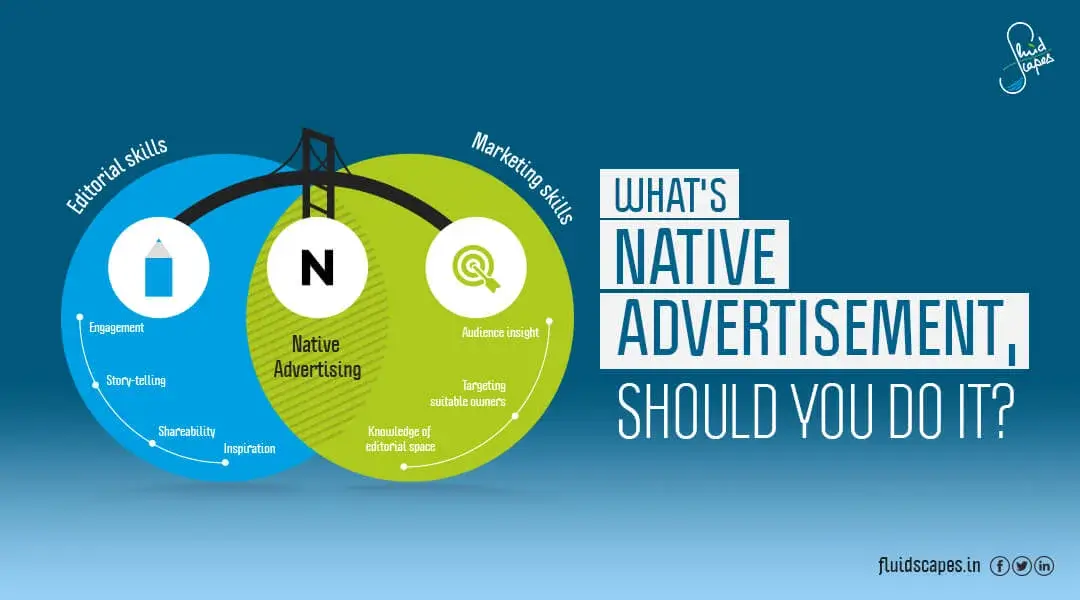
    What’s Native Advertisement, Should You Do It?

    With each passing day as digital marketing is expanding its boundary, it is becoming more and more competitive too. The unlimited wide range of Internet users presenting unlimited scopes for business growth alright, but it’s a test of business model, strategy, and techniques.

    Techniques are many, coming up one after another to provide new directions to digital marketing whenever it faces a new problem. The latest digital marketing technique that is creating a big buzz with its high efficacy rate is Native Advertising campaigns. Getting curious? Let’s dig into it.

    What is Native Advertising?

    There was (and still is) an old method of advertising, mainly used in the print media, called “sponsored articles,” which has been reinvented as “native advertising” for digital media. What was earlier used to be in the text-only mode now has a multi-dimensional form including text, image, infographics, and video.

    The best point about native advertising that makes it stand out is its non-intrusive nature. Native ads don’t really look like ads but part of the mother content. They are so well aligned with the style, tone, and type of natural content of the platform on which they get published that viewers can hardly differentiate between the two.

    And, that is the secret behind calling them native ads – they imbibe the native or original editorial content to meet their marketing goals.

    Why use Native Advertising?

    The main reason why people avoid or block traditional display ads is that they cause disruptions. Therefore, native content ads are a better approach to reach your target demographic because they blend seamlessly into the content and don’t cause distraction of mind to the users when they are viewing the main content; and data shows that it works.

    Native ads are more engaging and trustworthy, according to the newest native advertising statistics. They also produce more clicks and conversions than other types of advertising. Native display advertisements have an 8.8 times greater click-through rate (CTR) than ordinary display ads.

    Statistics reveal that Native ads are not perceived as advertising by 77% of users. As a result, native ads receive 53 percent more views than standard ads and have a 40-fold higher click-through rate than traditional display ads.

    Some people criticise native advertisements that they “look” like regular content and dupe people to believe they’re “genuine.” That simply isn’t the case – people click on them because they like the creative design of native ads.

    Native Ad examples

    Why have native ads gained such a scale of popularity? You can find out yourself by looking at the below examples – they never push a product or a brand, rather they create a story around concerns, worries, or other emotions that indirectly suggest using that product or brand for a solution.

    1.The Onion

    The Onion created this ad for its client H.R. Block, which is a tax consultant. The name of H.R.Block is only seen as the owner of this sponsored post and nowhere else on the ad. But the ad emphasizes the generally dull, dry topic of tax formalities in a pleasant, approachable, and extremely amusing manner, establishing a good reason to approach an expert for the job.

    2.Colored Corn

    Creating a tale is one of the most effective native strategies. And if the storey is visually appealing and vibrant, that’s even better. Take, for example, this piece of native content that was pushed on Business Insider.

    The example above has the appearance and feel of a standard Business Insider storey. Glass Gem Maize, a multi-colored corn variety, is the subject of the storey. It’s the storey of one man’s hunt for his Native American ancestors, which led to the development of colourful corn. The storey of the rainbow corn is presented in spectacular, bold, eye-catching pictures, in typical Business Insider style.

    3.Ikea puzzle

    Amusing Ikea A-Z puzzle designed to advise on how to have a good night’s sleep. This campaign, published on The Telegraph, avoids persuading readers like other native advertising, to buy a specific product in favour of using the company’s knowledge and skills to assist people with daily difficulties such as life, business, sleep (as mentioned above), or other aspects of life.

    Many of the native ads we see online these days are quite fantastic. Some are visually appealing, while others are unique, and yet others provide ideas for new methods to promote engaging content and acquire mindshare.

    Native advertising platforms

    Native advertising platforms are used by the advertisers to produce ads that blend in with the original content on a website. In the main news stream of social media platforms, for example, you will find ads that look very similar to organic posts.

    Below are some of the leading native ad platforms you may use to reach your audience:

    • Facebook Audience Network
    • Dable
    • Google AdSense
    • Verizon Media Native (formerly Gemini by Yahoo)
    • ReklamStore
    • AdPushup
    • Nativo
    • NativeAds
    • MGID
    • Outbrain
    • Taboola

    All native advertising platforms have one thing in common: they’re a useful tool for marketers looking to boost lead generation, conversions, and sales, as well as publishers looking to monetise their sites and improve user experience.

    Native advertisements platforms are meant to offer your content more exposure than it would get on your own channels. This is accomplished in two ways:

    • Placing your content on respectable and reliable information sites that have a high chance of attracting a larger audience. Because the material is designed to give insights and viewpoints rather than promotional and sales pitch, audience members are more likely to form favourable impressions of your company.
    • The implied endorsement from those publishing sites aids your content in overcoming “banner blindness,” which is becoming more common in digital advertising.

    Hopefully, this article has answered some of your questions concerning native advertising. If you choose this method for your own campaigns, it’s best to consult a competent digital marketing agency.

    Source- Fluidscapes
    We are one of the best digital marketing companies in India that provides online reputation management services to all types of organizations. We assist businesses to stay on top of the game by leveraging the latest technologies and breakthroughs in marketing strategies and business processes. Want to grow your business, even more, get in touch with us and we’ll tell you how.

  • Meme Marketing: Top Indian Brands That Are Leveraging Memes In Their Marketing Strategy

    Meme Marketing: Top Indian Brands That Are Leveraging Memes In Their Marketing Strategy

    Why do some things we remember but forget most others? It’s the emotion that makes things special to us and brings up the memories associated with them even after a long time.

    Humour and laughter generate positive emotions on social platforms. You made a mischievous joke and people burst into laughter – this picture will be imprinted in their memory and bring a smile to their faces ever after.

    Social media platforms are particularly known for expressive posts on trending topics that manifest all types of emotions. But unless the topic is sensitive, mostly it is the humorous, satiric, and engaged posts that become viral.

    Social media is flooded with various formats or types of humorous posts – text, infographics, short videos, etc. The latest addition to this list is Internet Memes which have become so popular that some companies are creating NFTs of Internet memes to launch their brands with a bang and also ensure future traction. Today, our topic is this only, memes for marketing. Let’s start with the very basic.

    What is a Meme?

    A meme is an encrypted message wrapped in fun. Formally known as Internet memes, these are usually made of images or videos punched with short texts that triggers fun or laughter to bring home an idea or a message. These cute little crackers spread via social media platforms, e-mails, forums, instant messaging apps, and even news websites.

    The best aspects of Internet memes are its two central attributes – creative reproduction of materials and intertextuality.

    Creative reproduction refers to remixes, parodies, or mashups that explain how memes cause ideas to move between people and cultures in the current events.

    Intertextuality is when one text in a work is linked to other texts in the social and textual matrix in some way.

    What is Meme Marketing?

    Real time marketing has always done experiments with humour in the ad campaigns to make a favourable impression in the minds of the consumers. So why not memes? It’s so powerful yet so inexpensive!

    Actually, the Meme marketing trend caught on in a big way because memes are the fastest growing digital assets spreading across all platforms and channels. Sharp wit, emotions, bizzare images and texts (sometimes non-grammatical) pieces of content help memes go viral in no time.

    Smart marketers are using memes cleverly in their marketing campaign which will help them viraling their brand messages embedded in humour. Memes don’t say anything directly, one has to be witty to enjoy them in their daily lives. The mix of creativity and refined humour is the usp of meme marketing, which helps a brand get practically promoted by the people when its meme becomes viral.

    How is Meme Marketing doing in India?

    Companies who have established a good marketing plan by speaking the language of millennials have been the first to recognise the potential of memes on social media.

    The prevalence of lively pop culture in India is fueling the growing appeal of meme marketing. Many popular memes are based on popular films and television shows. Characters from popular culture have become well-known among India’s many demographics. Several media firms, such as Amazon Prime, Hotstar, ALT Balaji are effectively exploiting the popularity and cross-cultural appeal of such fictitious characters.

    Following are a few leading brands across various fields that adopted meme form of marketing to run some of the spectacular digital marketing campaigns in recent times.

    Zomato

    Zomato definitely deserves the first place on the list due to the great amount of interest and engagement it has created with its “Harmonium Chacha” meme.

    Zomato’s target audience loves spending time on social media and the concept of meme marketing gave the company a great opportunity to connect with them through this funny meme.

    The campaign became an instant hit; it not only received huge likes and shares but also prompted people’s response with humorous comments and return memes.

    The original meme

    One response

    Another meme-

    Edelweiss Tokio Life Insurance

    Edelweiss Tokio Life Insurance launched a meme called “Thoda Aur Khayaal,” to promote their term product Edelweiss Tokio Life Zindagi Plus and our social media channels were flooded with posts and memes about it.

    Essentially, the goal was to persuade young customers to feel the urgency for life insurance for their family. The combination of humour and emotional element added that X factor that helped the meme go viral instantly.

    Kellogs

    Kellogg’s created a series of memes and postings with the hashtag #PhotoBombWithFills as part of their digital marketing for Valentine’s Day this year. The challenge went viral, and it drew a huge response online.

    Mahindra Blazo X

    Mahindra also devised a unique social media marketing plan that would generate more shares and likes. They came up with a contest using the hashtag #XtraGuaranteed to entice customers.

    Nestle

    Nestle’s Nescafe cold coffee launched hilarious memes featuring their brand ambassador Disha Patani that immediately garnered thousands of comments and shares.

    Even the OTT platforms are leveraging meme marketing to promote their brands and shows while also creating a point of engagement where consumers share memes on their profiles and among their friends.

    Netflix

    Netflix is one of the most effective meme users. Through memes, the brand has been incredibly involved with its social media followers. It has a separate sub-account called ‘Netflix is a joke,’ which is used solely for meme marketing. It not only creates memes, but also encourages users to develop and share their own. As a result, there is a common cultural experience that people may share and discuss and Netflix gains an increased reach and viewership.

    Another meme-

    ALT Balaji

    To entice viewers, ALT Balaji, a streaming channel, chose to promote its upcoming episodes and programmes by distributing hilarious GIFs, memes, and teaser clips. And it was successful!

    So, if you are a regular on social media the above examples definitely made you recall them instantly as each of them created a big buzz. This shows the increasing popularity of memes as a very effective marketing tool to make the best use of the country’s vibrant online user communities.

    Another meme-

    Source- Fluidscapes
    We are one of the best digital marketing companies in India that provides online reputation management services to all types of organizations. We assist businesses to stay on top of the game by leveraging the latest technologies and breakthroughs in marketing strategies and business processes. Want to grow your business, even more, get in touch with us and we’ll tell you how.

  • How Marketing Would Evolve In Next 10 Years?

    How Marketing Would Evolve In Next 10 Years?

    The economy thrives on business and business thrives on marketing. New challenges always come up in businesses, making it interesting to see how marketers embrace emerging technologies to tackle these challenges and ensure growth in the next 10 years.

    But it’s not just the technology that will make all the difference, the bigger challenge will be to understand the consumers. What will constitute the majority of the consumer behavior? Now we are standing in 2021. What will be the nuance and personality quarks of the consumers in the decade that has already started?

    So, it boils down to two distinct areas – demographics and technology – that will drive the evolution going forward in the marketing department. We will address them one by one.

    Demographics

    To make our prediction logical we can take a cue from the current scenario. Going by today’s data most of the purchasing is being done by the Millenials and Gen Z. They may all look young, but their responses to marketing campaigns are not the same.

    Marketers need to maintain a fine balance between the two as they will remain the dominant players for most of this decade before a third group called Gen Alpha attains adulthood towards the end. Let’s take a glance at the three groups and their unique traits –

    Millennials – Born between 1981 – 1994. In 2021 they are people between 27 -40 years of age.

    Gen Z – Born between 1995 – 2009. This means they belong to the age group between 12 – 26 in 2021.

    Gen Alpha – Younger siblings of Gen Z, born between 2010 – 2024, attaining adulthood in 2028.

    While Millennials can pay extra for a better customer experience, Gen Z stresses more on innovations to select a brand.

    Surveys reveal that 76% of the Millenials (against 71% of Gen Z) decide in favor of a company that has rendered a greater customer experience. Gen Z’ ers are more swayed towards newer versions of products and services and the use of digital channels by a company.

    Gen Z is less likely to trust a company than a Millennial

    According to a study in 2020, only 42% of Gen Z revealed to have trust in the companies against 50% of the Millennials. Both numbers have decreased significantly from the data collected in 2018 when 59% of Gen Z and 57% of Millennials said they felt their data wouldn’t be breached.

    Gen Z is less trusting by their nature than the Millenials, and there is not much the companies can do about it.

    Gen Z’ers spend more than the Millennials

    A high percentage of Gen Z is the only child of their parents and raised without any financial struggle, which developed a high spending habit in them. The Millenials in general were raised with siblings and had had no scope for extravagant spending.Gen Z values cutting edge solution whereas Millennials value authenticity more

    At all times, brands should try to be genuine. Those who do so will receive the rewards. Brands that promote transparency and reveal their principles are preferred by Millennials. Gen Z, on the other hand, is even more interested in selecting companies that reflect their values.

    Gen Z responds more to brand marketing than the Millennials

    Gen Z may be willing to pay extra for their favorite brands as a large percentage of them declare their liking for the brands. By contrast, the Millennials mostly show no affinity with any brand. They prefer to celebrate their independence. So the best marketing approach for the Millennials would be not to push for a specific brand.

    Gen Alpha

    Born into technology and affluence this group is the most materially endowed and technologically savvy generation ever. Though it’s impossible to correctly predict the purchasing behaviors of the Alphas, scientists have made the following hypotheses:

    • Trust and authenticity are more likely to influence their buying decisions.
    • Positive-impact or ethical brands are more likely to be purchased by them.
    • Tech-savvy, will respond well to social marketing and trust peer recommendations and is at ease with artificial intelligence.
    • More accepting of others than ever before – and intolerant of those who aren’t.
    • Will anticipate the highest levels of service and fulfillment as a child.

    Technology

    Digital marketing started with SEO marketing over 20 years ago and extended to social media marketing roughly around 2010. Both methods are very much prevalent today and adding new techniques to increase effectiveness. But another very powerful method has appeared by the name of “App Marketing”, which is setting a new direction for marketing on digital platforms.

    So, we can safely bet on these three cardinal approaches to build our marketing strategies going forward in the next 10 years. Let’s see what new trends are making ripples now as precursors to big waves in the future.

    Apps for branding

    Advent of apps has given marketers a unique opportunity to identify the niche segments, decision process, learn their needs, and develop solutions. A business can use this mobile marketing strategy in two ways – 1) by developing an app for itself and 2) through brand partnerships on 3rd party mobile apps

    Although app or mobile marketing is considered to be the future of marketing, the recent surge in competition is making lives difficult for marketers. On top of that, a few recent incidents exposed the data privacy risks in some leading apps. Nevertheless, with the level of buzz it has generated for internet users, one can conclude that app marketing will continue to dominate in the years to come.

    Voice Search

    The Google Voice Search or Voice SEO movement is rapidly gaining traction among online users since it allows for quicker, faster, and more conversational searching than standard query input. The technology is already matured as a few voice assistants are doing great in the home appliance segment.

    Voice search recognizes a voice inquiry and provides the appropriate response. The user is saved from typing the query, which comes as a great help in some compelling situations. We will see a percent increase in future as nearly 27% of web users worldwide are already utilizing mobile voice search.

    Featured Snippets

    The Featured Snippet, often known as no-click search, is the next big thing on the horizon. Featured Snippets are text samples, frequently with photos, from the articles that Google considers to be the most credible answer to a question and hence placed at the top of its search results in a box. Featured Snippets defy keyword-based SEO marketing principles to promote quality content and define a changing trend in content marketing.

    Visual Search

    Another excellent new technology example is Visual Search, which is an alternative to inputting a search term/keyword into Google Search, and is projected to be available in 2021. Users will be able to use Google to search for information on anything by submitting a photograph of the object.

    Visual search is an AI-based solution that, in addition to changing online searching, is poised to give eCommerce marketing a boost. The two most popular tools for integrating visual search technology into our daily lives are Google Lens and Pinterest Lens.

    Video Marketing

    In the digital realm, video marketing has a high engagement quotient. People are consuming video material in a variety of ways, from news feeds to social media and periodicals. During the Covid -19 shutdown, the popularity of videos increased, and it’s likely to continue to do so in 2021.

    Chatbots

    Because of their human-like intelligence, 24/7 availability, ability to recall your whole purchase history, rapid response capacity, and extreme patience, AI-powered Chatbots have become extremely popular in the digital marketing field (friendly and cordial at any stage). However, tailored chats are another feature of Chatbots that has helped them become a trendsetter in marketing.

    Influencer Marketing

    Influencing has massive power that forms the backbone of social media marketing. Influencers are the product of social media only, due to their unique nature of human networking. Through the right influencers, you can achieve your marketing objectives in an easier and cost-effective manner compared to other methods.

    Highly effective and meant for both B2C and B2B, influencer marketing is going to be an automatic choice for a marketing strategy for as long as social media continues to thrive. It’s cost-effective, organic in nature and a function of trust and word of mouth recommendation.

    Augmented reality (AR) based marketing

    AR is already making a revolution in the digital marketing realm and is expected to sweep the marketing strategies in the years to come. AR enables brands to provide customers with one-of-a-kind experiences through the use of their mobile devices. With augmented shopping experiences becoming increasingly popular, brands can employ AR to let consumers taste things before they buy them.

    The list is incomplete as we cannot accommodate all current and future trends in marketing in the limited space here, but the point we wish to drive home is that thorough insights into the consumer demographics and technological trends hold the future of marketing.

    Source- Fluidscapes
    We are one of the best digital marketing companies in India that provides online reputation management services to all types of organizations. We assist businesses to stay on top of the game by leveraging the latest technologies and breakthroughs in marketing strategies and business processes. Want to grow your business, even more, get in touch with us and we’ll tell you how.

  • What Is Growth Hacking? A Step By Step Guide To Growth Hacking

    What Is Growth Hacking? A Step By Step Guide To Growth Hacking

    It’s no surprise that digital technology continues to surprise us with its fathomless possibilities. Many of our beliefs and concepts are changing at the fundamental level. One such core concept that is undergoing rapid changes is that of marketing and growth of a new business – first, it took a big leap by changing from conventional marketing (traditional marketing) to digital marketing and then climbed to a new peak called “Growth Hacking”, a crazy egg.

    Growth is vital for the existence of a business. But conventional marketing tells a small business to survive first before expecting growth. Digital marketing renders a cost-effective and disciplined approach to improve branding as a means of achieving growth. Growth Hacking is a radically different idea that sees growth as the means of survival for startups in the marketing funnel, on the lines of offense is the best defense.

    What is Growth Hacking?

    As the name implies it’s hacking for growth. Here hacking should be taken for a positive connotation such as exploring quick, cheaper, effective, and customized ways to achieve growth, no matter if it has to shunt the usual practices. And the record says this works, almost always with amazing growth, provided the product is really good.

    How do you define growth? Growth is of course rise in turnover and profit, but to get there you must have a large and loyal user base. Normal digital marketing focuses on creating new target customers using many of its methods, which are centered around branding. The philosophy here is to improve branding and the culture of growth will automatically follow. This takes some time because branding involves relationship building and the generation of trust with potential customers.

    By contrast, growth hacking stresses growth from day one and applies out-of-the-box approaches to increase user bases and revenue from different traffic sources. The principles involve close monitoring, rapid recalculation for testing new buyer journey theories, and clever application of several techniques like referral marketing, incentivization, etc.

    This suits well for those startups that look to come into reckoning fast and cannot really afford to take the branding-first line. To generate a quick customer base and revenue the growth hackers resort to retaining and expanding the existing user base and also creating opportunities from the competitors’ bases. They closely follow different channels to track every stage in the customer journey and provide better solutions/offers to acquire the customer.

    The processes adopted in a growth hacking strategy are often a mix of digital marketing, data science, analysis, engineering, and design that aims at addressing unique wants, pain points, and questions of the active users.

    Below are some top growth hacking examples of startup businesses that have achieved meteoric rises in a short span of time:

    • AirBnB
    • Dollar Shave
    • Dropbox
    • Facebook
    • Foundr
    • Gmail
    • Groove
    • Grow and Convert
    • Groupon
    • Harvest Snaps
    • Hotmail
    • Hubspot
    • Instagram
    • KnudgeMe
    • LinkedIn
    • Monzo
    • Netflix
    • OptinMonster
    • Paypal
    • Proven
    • RJMetrics
    • Shazam
    • Slack

    In addition, we have some Indian superbrands like Flipcart, PayTM, and Ola who made it big by adopting growth hacking tactics as their core marketing strategy.

    Some of the growth hacking strategies that yield excellent results

    • Keep your email list ready – When it comes to generating leads and conversions for a business, email marketing still reigns supreme. Concentrate your efforts on growing an email list. It will enable you to communicate effectively with your target audience. Furthermore, email marketing aids businesses in creating pre-launch buzz for any product or event. It will also enable you to acquire potential clients prior to the introduction of your product. But don’t just sit there with a list of email addresses. Take a few weeks to build anticipation and make your audience excited for your debut.
    • Get the social media platform not used by your competitors – The idea is to dominate a social media platform where your established competitors are not present. It will help you to build a loyal following with unfettered access to them. You can also have traffic to your website from that social media platform and vice versa.
    • Sharing audience with another company – Obviously, you aren’t looking for a direct rival. Rather, concentrate on finding a company that compliments your own. You could, for example, sell handmade pet food. You may team up with a company that sells pet toys or custom collars.
    • Give away things for free – Freebies are a tried-and-true technique to quickly pique people’s interest in your business. One idea is to hold a well-publicized social media giveaway. To get people to participate, spread the word as widely as possible. You can also reward folks for telling their friends about your giveaway.
    • Referral marketing – Referrals from friends, family, and industry leaders convert leads significantly more quickly than other methods. Referral clients have a lower CPA (Cost-Per-Action), helping you to minimize costs as well. Uber began off as a ride-sharing service. Referral marketing was utilized to boost their brand awareness and user reach. The concept was simple: when other customers used their referral code, they received a $5 credit. The concept was so effective that it has subsequently been copied by every ride-sharing service.
    • Conduct A/B testing regularly – A/B testing on a regular basis is absolutely necessary for growth marketing. You’ll never come to know If anything has gone wrong with your digital asset unless you run the A/B testing. Although A/B testing must be conducted on all parts of your website, the most recommended areas are Landing Page, Home Page, Ends of Blog Posts, Contact page, etc. which receive maximum traffic attention.
    • Attend small local events – Try to grab opportunities to attend events that directly or indirectly relate to your product or service. You can go as a guest, a speaker, or even as an audience. These provide chances to meet people, learn about their needs, and introduce yourself as a solution provider to help to create a launching platform for your product.
    • Follow competitors – Competition can be in various forms, but it is always there. After you’ve identified your competition landscape, you’ll need to show why your company has a competitive advantage in each market. As an entrepreneur, make sure you’re not only focused on your business, but also on the shifting dynamics in your competitive landscape. This will enable your company to quickly change and capitalize on its strengths.

    The high success rate of growth marketing has come as a huge confidence booster for the young startup owners. If your product is good and relevant getting in touch with a growth hacker should be a high priority task.

    Source- Fluidscapes
    We are one of the best digital marketing companies in India that provides online reputation management services to all types of organizations. We assist businesses to stay on top of the game by leveraging the latest technologies and breakthroughs in marketing strategies and business processes. Want to grow your business, even more, get in touch with us and we’ll tell you how.

  • Benefits Of Having A Virtual Finance Department

    Benefits Of Having A Virtual Finance Department

    Poor handling of finance is a root cause of failure for numerous businesses, and efficient financial handling helps a business move ahead during difficult times. This basic tenet of business holds the keys to the survival and growth of a startup venture.

    But the irony is that finance is not a priority area for most startups at the initial stage. This may be due to a lack of awareness about how efficient finance handling can remove many roadblocks and create opportunities.

    Another reason may be that the startup owners usually aren’t seasoned businessmen in professional life and therefore more inclined towards revenue generation without caring for the need to maintain a healthy bottom-line.

    That is a fundamental mistake in cash management, the business owners often find out too late when suddenly they are faced with situations where they have utilized their available cash flow for operations without making budgetary allocation for tax incurred liabilities. This alone can cause a small business to liquidate.

    Also, some compliance criteria may appear that the company might have breached due to ignorance, imposing heavy penalties payable within the stipulated time. Situations like this eats up the profit earned and also force the company to hire a CFO or a senior financial expertise manager (more financial burden) to survive the threat of winding up.

    This is where a virtual finance department can come in as a viable, cost-effective, and trustworthy support service to address all your financial issues and also guide to accelerate the growth of your business performance. Wow, sounds great and just ideal for small startups that require nurturing by experts!

    So, what is a Virtual Finance Department?

    Whatever the size of a business, it needs to perform disciplined financial activities for growth. If you’re a startup or a small business and want to keep the upfront investment and risk minimum, this solution is practical and gives you more freedom to work when and where you want.

    As the name implies, a virtual finance department acts like your own finance department, but yes, it’s outsourced and operates remotely using the Internet(remote employees). It’s a group of financial experts with long exposure and experiences in handling a full range of financial functions of various sizes and types of businesses. The responsibilities or functions it performs include:

    • Bookkeeping and regular accounting services.
    • Management of the company’s cash flow.
    • Budgets and forecasting.
    • Advising and sourcing longer-term financing.
    • Management of Taxes.
    • Management of Company’s Investments.
    • Financial Reporting and analysis.
    • Assist managers in making key strategic decisions.

    The requirement may vary depending on the size and type of a business. Your requirement may be as basic as virtual bookkeeping, another company may require advanced level virtual accounting services, while a third company may be looking for full-fledged virtual finance management services or virtual CFO services.

    Benefits of Virtual Bookkeeping

    Bookkeeping is the most basic but essential financial practice of recording a company’s financial transactions daily. A properly updated ledger gives you many insights to make key decisions on operating, investing, and financing.

    Virtual bookkeeping ensures daily recording of financial transactions entirely from remote. Virtual bookkeepers telecommute to post the transactions into your electronic ledger from remote using bookkeeping software.

    Activity levels include: Accuracy, speed of work, the flexibility of working from remote, and cost effectiveness are some of the strong reasons that explain why you should hire a virtual bookkeeper.

    What other services are included in advanced Virtual Accounting Services?

    Besides virtual bookkeeping the other services covered in an advanced virtual accounting services are:

    • Periodic GST Filing.
    • Monthly TDS Payments, and Quarterly TDS Preparation and Filing.
    • Bank Statement Reconciliation.
    • Periodic P&L, Balance sheets, and other MIS reporting, where applicable.
    • General guidance, where needed.

    From a startup perspective, virtual accounting services present significant key advantages due to factors such as cost, accessibility from anywhere & anytime, no need to come to the office (in fact, small startups may not even have an office for that matter), and above all the combined experience and wisdom of a group of experts and their networks.

    The concept of virtual CFO and virtual finance department are synonymous with the startup culture. They match each other’s unique requirements, as was proved during the startup revolution in the US. India is the 3rd largest contributor to startup ventures in the world needs a large number of competent virtual finance departments to achieve a greater success ratio.

    Source- Fluidscapes
    We are one of the best digital marketing companies in India that provides online reputation management services to all types of organizations. We assist businesses to stay on top of the game by leveraging the latest technologies and breakthroughs in marketing strategies and business processes. Want to grow your business, even more, get in touch with us and we’ll tell you how.

  • What Is Venture Funding And Bank Financing? How We Can Help You With It?

    What Is Venture Funding And Bank Financing? How We Can Help You With It?

    When we talk about the startup ecosystem of a country it epitomizes many things at a time about the country and its people, such as the use of technology to change lives, risk-taking mentality, level of education, lab-to-market transition, business incubation, and availability of funding.

    India became the third-largest startup ecosystem in the world in 2019 based on the number of registered startups. But when it comes to transforming them into successful businesses, India lagged behind many other countries.

    This is no surprise because it takes time for a startup business idea to get matured. Moreover, changing the attitude of the people, government policies, and the bureaucratic process in a large and democratic country like India is a tectonic shift.

    But then, the economic survey report 2020-21 forced us to change our view of the matter.

    Despite the devastation of the business environment due to the pandemic for most of 2020, the country has produced 12 new unicorns (startups of $1b turnover), taking the total tally of Indian unicorns to 38.

    This speaks of how well the startup culture has caught the desire of the nation and drives its youth towards innovation and technology-based entrepreneurship; finding ways through a lot of adversities to develop solutions and successful business models. Yes, startup culture is built through struggles, failures, and successes in the business market.

    We all know how difficult the journey of a fledgling startup can be, numerous examples of promising startups nosedived after a perfect take off. Many times the failures are caused due to lack of financial planning and lack of management to handle critical situations such as business loans and debt financing. Also, the business model may not be foolproof.

    This led to the emergence of venture capital (VC) farms that offer funding along with nurturing and guidance to the infant startup ventures for acquiring stability and growth. Let’s look at it more closely in the below description.

    What is Venture Capital?

    Venture capital or venture funding is a private investment, which gets invested in hand-picked startup firms that have long-term growth potential. The owners and the management of the venture capital companies in most cases are technocrats and management experts who evaluate the startup idea and scopes and get involved in it as a partner or financier, in exchange for the equity stake if the ideas are found viable.

    Venture capitalists are generally well-off investors who have the insights to recognize jewels. Today, investment banks and other financial institutions are also coming forward with funding options to invest in prospective startups or in small companies that are on a fast growth trajectory with a solid business plan. This provides the investment companies the potential for above-average returns.

    The difference between the venture capitalists and other investors is that while the investors are only interested in getting high returns from their investments, venture capitalists tend to become partners, share their business expertise in the ventures and help the owners navigate the difficulties on the path to achieve success.

    Advantages of venture capitals

    For new companies or ventures that have a limited operating history and exposures to nitty-gritty of bank financing, govt. regulations, compliance, etc. venture capital fundings are becoming increasingly popular sources for raising capital. The major advantages are:

    1. Ready flow of funds at the crucial junctures throughout its journey
    2. All the benefits of having an informed, matured, and trustworthy partner
    3. Assistance in building networks and connections
    4. No pressure or obligation for repayment
    5. Easy accessibility

    Different types of venture funding

    Venture capitals can be pumped into a business at various stages, which define the types of venture capital. They are:

    • Seed funding – Seed funding or seed capital is the funding that helps a company conduct business activities at the initial stage that include market research, product research, business plan creation, business decisions, and the like.
    • Start-up capital – This includes capital that is required to set up an office, create prototypes, or recruit crucial personnel, etc in a startup phase.
    • First stage or first round capital – This funding is required once a product is tested and ready for manufacturing, and also for the immediate marketing and sales activities.
    • Expansion capital – This includes the funding required for the expansion of the ongoing business. The ideal applications are tapping new markets, developing new products, acquiring new equipment or technology, or even acquiring a new company.
    • Late stage capital – Late or the last stage of venture funding may be required if the company decides to go public after creating a high reputation and strong customer base. The fund is used to meet the expenses for creating the initial public offering (IPO).

    Bank Financing

    Bank financing is another option left with the startup companies to arrange funding at various stages of their business lifecycle. There are provisions for many types of term loans, working capitals, or collateral loans depending upon requirements and the repayment terms. Banks can loan to a startup if it meets the following conditions

    1. The business model is found to be satisfactory
    2. Projected returns from the business are satisfactory
    3. Ability to pay back the loan through business or otherwise is satisfactory

    How to get bank financing for the startup engaged in novel areas?

    Even if your startup is engaged in a novel area where it’s being difficult to establish a business model, banks will ask for higher collateral security coverage from one or more sources of income.

    Different types of bank financing available for startups and small businesses.

    There can be 10 different types of bank loans available to encourage entrepreneurship in India, each type is best suited for a unique situation.

    • Term loan
    • Startup loan
    • Working capital loan
    • Loan against property
    • Invoice financing
    • Equipment financing
    • Business loan for women
    • Overdraft
    • Merchant cash advance
    • Business credit card

    Source- Fluidscapes
    We are one of the best digital marketing companies in India that provides online reputation management services to all types of organizations. We assist businesses to stay on top of the game by leveraging the latest technologies and breakthroughs in marketing strategies and business processes. Want to grow your business, even more, get in touch with us and we’ll tell you how.

  • What Is Project Management Exactly? Tips To Better Your Project Management Skills

    What Is Project Management Exactly? Tips To Better Your Project Management Skills

    Whatever may be the nature and size of your organization, going digital should be a priority to accomplish an overall efficiency boost. Going digital may have different implications ranging from addressing a local or departmental requirement through technology up-gradation to streamlining the individual departmental automation processes, to the full-fledged transformation of processes and culture of your business.

    Any transformation is essentially a disruption or destruction of the conventional system and thought processes. Digital transformation of your organization may be painful initially causing a drop in the performance graph before flying upward.

    However, here is a word of caution. A large percentage of digital transformation projects fail to yield the desired result due to mistakes at some stages. But that doesn’t mean that the value of the endeavor is worth nothing or your project costs have gone to waste totally. There are many intricate processes involved. Many a time it turns out to be the wrong implementation of one or more processes that are hindering success. Identification and correction of mistakes by a superior project management company remove the roadblock to your business transformation goals.

    So the lesson we have learned up till here is that although the digital transformation is essential for the sustenance of business, its implementation is tricky and prone to mistakes that call for efficient project management services.

    But what is project management, especially in the context of digital transformation?

    Project management is a group of processes and activities that are implemented/performed in a logical order to achieve an expected result. The person who organises/manages all the activities in a project plan directly or indirectly is called the Project manager. The Project Manager should be a good taskmaster so that the project can be delivered within the limitations such as time, cost, people, risk, etc.

    Digital transformation is a difficult project because it transforms the traditional methods of business processes into digital methods that perform in perfect synergy. It ensures cooperation by the staff and management and their training. The goal of digital transformation project management is to transform a business to become more efficient, prompt, customer-caring, and profit-making.

    What are project management tools, and why do you require them?

    Project planning generally consists of many types of tasks that are to be performed by different groups of people and experts. Project management tools help to create and distribute tasks to the selected people for seamless collaboration and to establish a hierarchy for effective and efficient completion. Some of the best project management tools are:

    • Wrike
    • ClickUp
    • monday.com
    • FunctionFox
    • Nutcache
    • TeamGantt
    • Slack
    • ProWorkflow
    • KeepSolid Goals

    Project Management strategies

    Your organisation could be at one of the three basic levels as given below:

    • A fully established process might be in place, which is working fine and has good adaptability.
    • A process might be running but requires fine-tuning and expansion.
    • There might not be any process in place.

    You need to think about adopting an appropriate strategy if you are in a situation that matches either #2 or #3 in the above list. Following steps, you may undertake to improve your current digital project management methodology process or establish a new one to give your business planning a new dimension.

    • Use of Tools – There are many Project Management software and tools (some of them mentioned above) available for task or process creation and development. The most common types of these tools are workflow management softwares, change process management softwares, and business process management softwares.
    • Designating a process owner – You must designate a person or group in charge to create a process and oversee its functioning. Project teams or an individual act as the central hub for processes and give final approval on processes.

    How our project management services benefit the technology up-gradation of your business?

    The various stages of project management are:

    • Initiating
    • Planning
    • Executing
    • Monitoring & Controlling
    • Closing

    Although new applications and solutions continually pushing the boundaries, our approach strikes a balance between futuristic technology and cost-effectiveness. Quality is maintained all through the project to ensure that the core project goals are achieved along with a high level of customer satisfaction. Below are the glimpses of how individual departments and activities get benefitted through the essential project management services.

    Human Resource Management – We implement advanced cloud-based HR solutions that provide comprehensive, fast, and easy ways for the HR department to search and contact employees, store and retrieve data, analyze the performance of the employees, and make an authentic profile of the employees.

    Infrastructure Management – Infrastructure management consists of systems management, network management, and storage management. Our project consultants provide technology solutions to render perfect synergy between them.

    Web-based App Development – App development projects have to meet underlying conditions such as a high degree of performance, keeping it within budget, and meeting the deadline. Our successful project managers maintain excellent interfacing with the clients and the development team to complete the project within schedule.

    Inventory Management Systems – Our project consultants ensure the development of efficient inventory management solutions that involve a wide scope of processes ranging from inventory forecasting, replenishment, demand forecasting as well as quality management.

    Data Analytics – Project to develop data analysis tools that serve the companies profoundly in many ways, such as close understanding of their customers, evaluation of ad campaigns, creating content strategies, and product development.

    CRM Systems – Development and implementation of CRM software to track, manage, and collect customer interaction data.

    Source- Fluidscapes
    We are one of the best digital marketing companies in India that provides online reputation management services to all types of organizations. We assist businesses to stay on top of the game by leveraging the latest technologies and breakthroughs in marketing strategies and business processes. Want to grow your business, even more, get in touch with us and we’ll tell you how.
  • We Explained On-Page SEO Vs Off-Page SEO Like You Are Five

    We Explained On-Page SEO Vs Off-Page SEO Like You Are Five

    The Search engine is the origin of digital marketing and has been evolving like no other field in modern times. Google holding over 89% of the search engine market continues to be like a cauldron of changes and updates to optimize the efficiency of digital marketing continually.

    The search engine which was initially developed to help with browsing for the right information soon found to be a source of immense possibilities to identify and connect with the probable customers. That was the beginning of digital marketing, which spread like wildfire based on new methods of search engine optimization with increasingly accurate results.

    Search engine optimization or simply SEO is a method of inbound marketing that employs various strategies to generate interest in the netizens’ minds for your product or service and convince them to visit your website to buy the same.

    The effort is always on by Google, Bing, Yahoo, and other search engine companies to innovate new ways to hook potential customers and get more organic traffic, which is leading to many SEO techniques both on-page and off-page. As the competition is getting fiercer in the digital space, the need for sharper SEO strategies is rising high in demand, and is making it obvious for the businesses to look out for a combination of on-page and off-page SEO methods.

    What is On-Page SEO?

    This includes the conventional SEO measures taken to improve your position in search rankings. These methods are implemented directly onto the page sources of your website and help it occupy a higher position on the search engine result pages (SERP). Since the source code of your website is your property the control in your On-page SEO is always in your hands.

    The three fundamental On-page SEO tactics are:

    • Using highly searched keywords and key phrases in the page titles and content. Although the focus is shifting from keyword stuffing to quality improvement of the content.
    • Adding alt attribute to the tag in the HTML code
    • Optimizing the meta description to increase the ranking of your website and achieve more traffic.

    On-Page SEO factors

    The Factors that matter most in On-page SEO are

    • Content Quality & Structure – Quality of your web page content (both text and images) and their formats are vital to attract the attention of the visitors and arouse their interest in your product.
    • Keywords – Keywords are definitely not as important as they were a few years ago, but are still practiced as an important part of On-page SEO.
    • Meta Title or Title Tag – Meta title is the title of your web page (usually blog or other large article) that is also used as the heading on the SERP for that web page. This can be only 65 characters long.
    • Meta Description – It’s the short description of the article that appears below the meta title on a SERP. It’s written intelligently using target based keywords to give a brief outline of the blog or the webpage article as well as to generate interest instantaneously about your web page content in the minds of the visitors.
    • SSL / HTTPS – Enabling Secure Socket Layer (SSL) security technology for Internet access improves the trustworthiness and visibility of your website. Google prefers sites with HTTPS URL, which ensures the selection of your website in the SERP.
    • URL Optimization – This involves using keywords in the URL structure to earn more clicks and make navigation more efficient because the search engines can crawl from page to page on your website more easily. URLs should also be short using only the primary keywords and should look like a natural link.
    • Internal Linking – This is another very important On-page SEO factor that links related pages on your website using links on the individual web page content. This helps the search engine to crawl through your site easily and keeps your visitors engaged for more time.
    • Breadcrumb Navigation – For websites that have many pages, breadcrumb navigation makes it easy for the visitors to find their way around. Breadcrumbs help to land on the desired page directly, reducing the number of actions or steps in between. Therefore, breadcrumbs make navigation faster and increase the chances for the visitor to explore your site.
    • PWA – Having a PWA (Progressive Web Application) website ensures that your website can be seen and navigated on any device (mobile, tablet, laptop) with equal ease. This brings much more users to your site because these days people use multiple devices to browse at different hours.
    • Schema Markup & Rich Snippets – Schema markup is a fantastic way to put out some useful additional information about your product or service in the form of rich snippets when searched by Google. This is done by embedding the additional data into your website code. When Google search engine scans your website’s source code for mentions of the searched product then these additional information (name, address, phone numbers, ratings, reviews, and the like) also get displayed on the SERP along with the product, highlighted in a rich snippet box.
    • Core Web Vitals – Introduced recently by Google, this gives a realistic view of your web page performances by quantifying the users’ experiences of your site, so that you come to know about the strong and weak areas of your site.
      Core Web Vitals are going to influence your On-page SEO in a big way as they reflect the real-world experiences of the visitors from visiting your website. Currently, the three aspects of your website that are being covered by the Core Web Vitals are loading, interactivity, and visual stability. More aspects such as mobile-friendliness, safe browsing, HTTPS, non-intrusive interstitials will soon be added to the list to make it a more comprehensive collection of user experience data.

    What is Off-Page SEO?

    As said earlier, Off-page SEO services depend on the activities of your website such as gaining traffic through backlink profiles on other websites, linking social media accounts to websites, etc. The common Off-page SEO techniques are:

    • Backlinks – Backlinks redirect the visitors from other sites to your website and improves your rate of conversion. There are several approaches that can generate huge organic traffic through backlinks, such as:
      • Guest blogging on popular blog sites with large subscribers
      • Being featured in industry trade publications
      • Republishing your content on a popular site in the same industry as yours
      • Participating in an industry community such as a forum
      • Guesting on a podcast
      • Press Releases
      • Hosting events (in person or virtual)
      • Help A Reporter Out [HARO]
    • Anchor Texts – Anchor text is the hyperlinked characters or words that link to another content or location on the web. Anchor texts also result in Off-page SEO effects as they provide both search engines and users with the relevant information about the content of the link’s destination.
    • Domain Authority – Domain authority of your website is the strength of your website, determined by the number (1-100) given to you by a search engine, say Google. Clearly, websites with higher domain authority receive preference from Google and get higher rankings on the SERP. Link building tactic includes gaining quality backlinks to your website from other popular sites helps to raise your domain authority. Creating high-standard content for guest blogging and republishing on other websites to gain quality backlinks is a way for achieving high domain authority.
    • Social Media Posts – Social media posts with links to your website also helps to gain high traffic.Creating interesting posts and joining the right group are the keys to success in this method.
    • Local Listing – Local listing on sites like Google My Business, Yelp, and others with favourable reviews has been a major push to businesses that depend upon local customers. Local listing of the name, address, phone numbers, nature of business, etc. is providing great traction for small businesses and local entrepreneurs.

    Source- Fluidscapes
    We are one of the best digital marketing companies in India that provides online reputation management services to all types of organizations. We assist businesses to stay on top of the game by leveraging the latest technologies and breakthroughs in marketing strategies and business processes. Want to grow your business, even more, get in touch with us and we’ll tell you how.