Blog

  • 7 Quick Facts You Should Know About SEO

    7 Quick Facts You Should Know About SEO

    Going online and having an SEO-friendly website are the two primary requirements for any business, because a good online presence provides a competitive edge and takes the business beyond boundaries.

    A business cannot sustain it if there are not enough requirements for the product it deals in. The requirement is generated through search. The higher the number of searches the bigger the volume of requirements. Business owners and marketers are single-mindedly going for SEO in the first place.

    Conventional or retail businesses usually depend on the local market and therefore face smaller prospects and limited requirements. Online business armed with SEO provides access to more markets and ushers in bigger growth opportunities.

    So, what is SEO and what are the benefits of SEO?

    SEO is the short form of the key process called “search engine optimization.” In layman’s terms, it refers to a technique of improving the visibility of your website so that it appears more prominently when people search for products or services related to your company on Google, Bing, and other search engines. The higher your pages appear in search results, the more likely you are to attract attention and attract new customers to your business.

    Search engine optimization is a critical component of digital marketing, because people conduct trillions of searches each year, often with the commercial intent of finding information about products and services,

    Search is frequently the primary source of digital traffic for brands, and it works in tandem with other marketing channels. Greater visibility and higher ranking in search results than your competitors can have a significant impact on your bottom line. The following are a few proven SEO impacts that translate into higher growth for a business:

    • It ensures a better user experience.
    • It generates valuable leads for your business.
    • It results in increasing closing rates.
    • It causes physical visits by the local customers / prospects to your retail store.
    • It results in better cost management.

    Interesting SEO statistics or SEO facts emerged in 2022.

    • A search engine is the starting point for 68% of online experiences.
    • Google (including Google Images) currently controls 91.94% of the total search engine market, followed by Bing, Yahoo!, Baidu, and YANDEX.
    • According to 61% of B2B marketers, SEO and organic traffic generate more leads than any other marketing initiative.
    • Even if the purchase is made in a store, 63% of all shopping begins online.
    • According to 70% of online marketers, SEO outperforms PPC in terms of generating sales.
    • The top page in a Google search has a 32% average click-through rate.
    • 75% of people never go beyond the first page of search results.
    • Before making an online purchase, 66% of people conduct some type of online research.
    • The average Google first-page result contains 1,447 words.
    • Search engine leads have a 14.6% close rate, while outbound leads (such as cold calling, direct mail, and so on) have a 1.7% close rate.
    • 86% of people ignore paid banner ads in favour of organic search results.
    • Bounce rates rise by 9% when your website takes 2 seconds to load and 38% when it takes 5 seconds.
    • Every extra second it takes for your website to load reduces conversion rates by 4.42%.

    Top SEO trends and updates in 2022.

    Although the fundamental principles of SEO remain constant, the SEO algorithm updates and search trends evolve from time to time, which influences how we optimize our web pages. How has the advancement of search engine technology influenced your strategy this year? The following were the top SEO updates in 2022 that kept the traffic and keyword rankings on the rise:

    • Core Web Vitals
    • Keyword clustering
    • AI-generated content
    • People also ask
    • Content optimization software
    • Rich snippets
    • The democratization of search

    #1. Core Web Vitals

    This is about improving the user experience by using the following performance metrics:

    • Largest Contentful Paint (LCP): the time it takes for the page’s largest content asset to load.
    • First Input Delay (FID): the amount of time it takes your site to respond to a user’s first interaction with the page.
    • Cumulative Layout Shift (CLS): the number of unexpected layout shifts that occur during the page’s lifespan.

    #2. Keyword Clustering

    Keyword clustering is a more advanced keyword strategy that can help you improve your overall keyword rankings. It entails locating multiple keywords with similar search intent and using more of these clusters in developing web pages.

    #3. AI Generated Content

    AI-assisted SEO content tools such as CopyAi, Headlime, Jarvis, and others are on the rise, enabling content teams to produce more SEO-optimized content at a faster rate. With a few inputs, these tools can generate topics, titles, meta tags, paragraphs, and even entire articles.

    #4. People Also Ask

    The “People also ask” feature on Google’s search page now appears for approximately 48.6% of searches. Because of its prominent placement at the top of the SERP (and frequently above position one), everyone will want to rank their content in this coveted SERP feature.

    #5. Content Optimization Tools

    Content optimization tools can assist you in producing high-quality, semantically-rich content that ranks higher in Google searches. These tools identify keywords, subtopics, synonyms, and even common questions search engine crawlers are looking for on the page when promoting content using similar NLP algorithms as Google.

    #6. Rich Snippets

    Rich snippets assist Google crawlers in showing users the exact content they’re looking for, resulting in a better user experience. Schema markup is a microdata vocabulary that helps Google better understand and extract content from your pages, allowing them to appear as rich snippets that are more appealing and clickable for users.

    #7. Democratization of Search

    Although backlinks and Domain Authority are still important in 2022, search has become more democratic. Incumbents cannot rely solely on their authority signals to maintain top keyword positions, and newer websites have a better chance of ranking if they provide users with a high-quality, high-performing web experience.

    Source- Fluidscapes
    We are one of the best digital marketing companies in India that provides online reputation management services to all types of organizations. We assist businesses to stay on top of the game by leveraging the latest technologies and breakthroughs in marketing strategies and business processes. Want to grow your business, even more, get in touch with us and we’ll tell you how.
  • Should An eCommerce Store Have An App?

    Should An eCommerce Store Have An App?

    Using the right technology at the right time is a forward-looking attitude that helps a business register sustainable growth. Although the growth achieved by the Indian ecommerce industry in the past few years has been nothing less than phenomenal, it might reach the saturation point if it doesn’t identify the ensuing challenges and address them with innovation and technology.

    The years of lockdown gave an extra fillip to the ecommerce industry, which saw a rapid increase in the number of ecommerce stores at all levels. This is expected to boost further once the ONDC is in place to democratize ecommerce in India.

    But how to ensure customer loyalty when there are many ecommerce stores around? The rise in competition compels ecommerce companies to search for prospective customers and connect with them directly to showcase the products or services they are likely to buy.

    Addressing the challenges like these holds the future of ecommerce and forces owners to look at mobiles for solutions. Because mobile or smartphone users are naturally networked and trackable, they form a large chunk of potential customers, which is relatively easy to tap and use for making direct communication.

    Making direct and proactive communication with the end customers allows ecommerce to shorten their product supply-chain and provide the product or service of choice to them. And what can be a better solution than a mobile ecommerce app, for making direct or one-to-one communication with a customer?

    Mobile or smartphone consumption is going through the roof. India will likely have over 800 million smartphone users in 2022, and a large number of them will be glued to their handset for extended hours. So, what do your senses tell you if you are an ecommerce owner? Most likely, it would be to invest in your ecommerce mobile app development on a priority basis.

    Reasons for ecommerce app development on mobile

    #1. Ease of use, more flexibility, and access to billions of users

    People are on their mobile phones for almost everything they do: order food, book flights, pay bills, etc., because with mobile apps they can do everything with a single finger.

    Remember, you can use mobile apps on your tablet as well as your smartphone. Therefore, you will be able to build a brand based on the billions of users and devices that exist today.

    #2. Convenience of using ecommerce app vs. website

    With the cheaper data and meteoric rise in smartphone use, people remain online for a longer time and access the Internet anywhere, anytime. As a result, online searching and ordering takes place without any restriction of place and time, even when the people are traveling or are outside their homes.

    And what has made online ordering more convenient are the mobile apps. They basically translate the complex processes into a few simple steps. This makes things much easier and more straightforward for the customers, compared to using the website for the same. Because of this, mobile apps tend to have a higher conversion rate than websites on mobile browsers.

    #3. More engagement with existing customers and acquisition of new customers

    A mobile ecommerce application can introduce new customers to your company while also better serving existing customers by promoting new products and services, special offers, loyalty programmes, and so on. In turn, the company benefits from brand promotion and the opportunity to learn more about its customer base and their preferences. Companies will only benefit from going mobile by making their goods and services more accessible, easier to obtain, and use.

    Benefits of e-Commerce mobile app

    A mobile app provides numerous benefits, such as increasing user engagement and providing excellent marketing opportunities, as well as increasing average purchase price, revenue, and brand loyalty, allowing businesses to stay ahead of the competition. Let’s take a look at the most important advantages of having a mobile application for a business:

    #1. Improved Customer satisfaction level

    The goal of a mobile app is to meet the needs of consumers by providing comfort and ease of use of the services offered. It is far more dependable and personalized than traditional websites. It caters to the consumers’ “need for speed” by making any step to achieve their goals as easy and quickly without having to go through a series of clicks.

    #2. Improved data analytics and marketing campaigns

    A mobile app allows businesses to efficiently collect, analyze, and leverage customer data, which is critical for marketing and advertising, because the data collected allows you to make insight-driven decisions to improve your services.

    Apps enable businesses to use data-driven marketing tactics to provide a highly personalized experience for their customers by understanding their product preferences, search trends, and feedback. For example, marketers plan out various promotional and special offers to boost customer acquisition and loyalty.

    With push notifications, an app can quickly remind consumers of the last date of offer or new arrival of products to expedite purchase. This significantly increases mobile app engagement. Almost nine out of ten people surveyed by Google find shopping notifications on mobile useful if they add value.

    Furthermore, mobile apps provide vital insights into how long customers spend on the app, which functions are used the most and which are less, so content and features can be tailored to offer customers the content they want more effectively.

    #3. As an effective tool for branding

    Creating a custom mobile app helps you to gain a large number of new users cum potential customers who are more at ease using apps over other channels.

    Because mobile apps are always available on everyone’s phone, they serve as a source for obtaining all relevant information about your brand as well as a platform for showcasing new products and services. This certainly improves a brand’s digital image and allows businesses to form closer relationships with their customers.

    #4. Easy and hassle-free payment

    The majority of mobile apps allow you to connect one or more of your existing financial accounts to an integrated payment system. Such linking enables payment for goods to be made directly from the application, without the need for additional authentication with other resources. Customers save time by not having to enter their information multiple times.

    #5. Improving loyalty and brand awareness

    Mobile apps require minimal effort to search, explore, and order desired products or services in a matter of minutes, resulting in the best possible shopping experience. The more people interact with your brand and become satisfied with your business and services, the more they will reciprocate by increasing brand visibility, recommending you to their friends, and thus maximizing profits.

    Integrating personalization options and loyalty incentives options into the mobile app is a subtle way to build and keep a customer community. Customers are most likely to return if their purchases are rewarded with cash back, discounts, or bonuses.

    Building mutually beneficial relationships with customers leads to them becoming loyal users and brand advocates.

    Source- Fluidscapes
    We are one of the best digital marketing companies in India that provides online reputation management services to all types of organizations. We assist businesses to stay on top of the game by leveraging the latest technologies and breakthroughs in marketing strategies and business processes. Want to grow your business, even more, get in touch with us and we’ll tell you how.
  • Grow Your YouTube With SEO | The 7 Steps Guide

    Grow Your YouTube With SEO | The 7 Steps Guide

    Videos are great attention grabbers, excellent for engaging viewers. YouTube is the undisputed leader in video marketing and that can take your business to the next level if you can apply digital marketing strategies deftly. YouTube SEO is an all-important tool that helps your video rank high on the YT search results – the rest depends on the quality of the content.

    What is YouTube SEO and How it works

    We know that SEO is the process of optimizing content, so they rank higher in search engine results pages (SERPs). Similarly, YouTube SEO optimizes videos to rank high in YouTube search results.

    However, unlike Google, which evaluates rank based on backlinks and other factors, YouTube’s SEO strategy entails optimizing your channel, playlists, metadata, descriptions, and videos. Your videos can be optimized for search both within and outside of YouTube.

    The YouTube algorithm that ranks the videos in the search results for the queries is called “Page Rank,” which decides the order in which the results appear when people search on YouTube. The factors that affect the optimization of your videos are:

    • how relevant the content is to the search terms being used
    • popularity of the site that has posted the videos
    • How authentic is the source of the video
    • How many links come into the video.

    These are the common points that must be remembered when you set your YouTube SEO strategy.

    Why is YouTube SEO important for your videos?

    With at least 2.56 billion active users, YouTube is the second most popular social platform. Your videos will receive a lot of traffic if you rank high on YouTube. Videos and YouTube are such a powerful duo that every business wishes to have a YouTube account to run its videos. Without YouTube traffic, it’s nearly impossible to rank well on Google,

    It’s important to know how to rank YouTube videos fast when uploading a video to your YouTube channel because you are competing with 72 hours of new videos uploaded every minute on the platform. In order to be seen and heard among all the other noise, your content should have the major YouTube SEO checklist.

    YouTube performs well in the search engine’s algorithm because it is a Google product. This means that your videos are more likely to appear in search results, especially if you’ve implemented the proper search engine optimization (SEO) practices. If you want to launch your YouTube channel and are looking for YouTube SEO for beginners, here are the top 7 YouTube SEO tips:

    #1. Customize the URL

    Customizing your YouTube URL allows you to share your page more easily while also adding legitimacy to your channel. According to Google, your channel must have the following features to be eligible for a custom URL:

    • There should be at least 100 subscribers.
    • Should be made at least 30 days ago.
    • Having a suitable profile picture
    • Having a banner image

    Once approved, you can create your custom URL through your basic information settings, an email notification, or a notification on your channel’s dashboard. Make sure the URL accurately represents your company and is easy to remember for the best results. Your URL will be youtube.com/yourcustomizedname once created.

    Add a 30-60 second channel trailer to your YouTube page to make a great first impression.

    #2. Have a short, smart, and informative about page

    When it comes to effective YouTube SEO, it’s critical to take advantage of every available feature to provide additional context about your page. To do so, make sure to finish your YouTube channel’s About page and include important information about your company.

    Because only the first 48 characters of your About section will be displayed in search results, describing yourself succinctly with relevant keywords can improve on-page search visibility.

    Choose a thumbnail and main banner for your channel that feels like an extension of your website.

    #3. Use a crisp and keyword-rich title and description

    Once your page is up and running, make sure that you always include keyword-rich titles and descriptions for each video you upload. Before uploading your raw video files to the platform, rename them with a target keyword.

    Keep your title to 60 characters or less to avoid having it cut off in results pages.

    While descriptions can be up to 5,000 characters long, only about 100 will appear beneath the video before prompting a “Read more…” option. As a result, it’s critical to get the main points across early in the description, along with a call to action (CTA) if applicable.

    You can also add transcriptions to the description section for all of your videos. Text transcriptions will most likely naturally target keywords. This can assist crawlers with better understanding the video’s content.

    The use of relevant keywords in video tags is another way to tell YouTube what the video is about.

    #4. Use unique video thumbnails

    Making your video thumbnails unique will help your videos stand out. It’s also a good way to make your overall page look professional and comprehensive. Thumbnails can be customized with elements such as:

    • Dynamic, brand-specific colours
    • Banners
    • Keyword-rich thumbnail text
    • Distinctive title cards

    If you don’t customize your thumbnails, the YouTube platform will frequently choose a still from your video at random, which may make your channel appear less cohesive.

    Be sure to mark up your videos with Schema tags if you add them to your website.

    #5. Make a playlist to increase watching time.

    On YouTube, the most important metric is watch time, which is increased by threading together multiple videos on similar subjects into playlists. Viewers can select videos from a playlist, and the videos in the playlist will play automatically rather than requiring them to select each individually.

    Relevance, engagement, quality, and personalization are the factors that influence the YouTube ranking. You could make playlists for webinars, client testimonials, how-tos, or frequently asked questions based on your videos and industry.

    #6. Take all measures to increase your subscriber base

    You can improve your YouTube SEO by focusing on increasing the number of subscribers to your channel. Embedding videos in emails and on your website (such as landing pages and blogs) is a great way to get your channel noticed.

    You can promote each video with a blog post, or you can cross-promote your videos and channel with e-books, webinars, presentations, and lead magnets.

    If you do include videos on your website, make sure they are properly tagged with Schema tags for video. This may also help videos rank higher in search results. Google Search Console provides video Schema reporting, which can be useful for gathering insights.

    #7. Add captions or subtitles

    By adding captions or subtitles to your videos, you can reach a wider audience. This makes your videos more ADA compliant, inclusive, and accessible to those who are deaf or hard of hearing. Moreover, it allows you to reach viewers who may not want the sound on because they are in a quiet environment or do not have headphones.

    There are numerous options for creating captions or subtitles these days. While auto-generated captions may be faster or less expensive, they are more prone to errors because the audio is not being transcribed by a human.

    Wrap up

    It can be very profitable for your business to increase exposure to a YouTube channel, but it heavily depends upon how you promote your YouTube channel . You can better position your video content to appear in search engine results and reach as many viewers as possible by following YouTube SEO best practices.

    Source- Fluidscapes
    We are one of the best digital marketing companies in India that provides online reputation management services to all types of organizations. We assist businesses to stay on top of the game by leveraging the latest technologies and breakthroughs in marketing strategies and business processes. Want to grow your business, even more, get in touch with us and we’ll tell you how.

  • Know How To Turn Negative Into Positive With Online Reputation Management (ORM)

    Know How To Turn Negative Into Positive With Online Reputation Management (ORM)

    The search engine and social media are the two things that are immensely important for the sustenance and growth of a business. While proper handling of these two vital tools can establish your brand quickly, a callous handling of the same can also tarnish your brand in no time. Online reputation management is a mastery of using the search engine and social media to make a business or brand popular and favorite.

    Today, all businesses are going online because the online marketplace is expanding at a lightning speed. It has no bar in terms of time and distance, which can flood a business with opportunities. But at the same time, it brings forth the mistakes and weak points of a business to the public, which can ruin its prospects with negative reviews and comments. Online reputation management shows how to respond to negative feedback.

    Customers’ feedback is crucial in today’s business as they influence purchase decisions more than advertising and other marketing practices. You can receive feedback through your website, social media profiles, and other Web 2.0 platforms. Online reputation management monitors, analyses, and responds appropriately to all types of feedback in a manner that buttresses your reputation and brand equity.

    How does online reputation management handle negative feedback?

    Customers are way more informed and interactive in the digital age because they can shoot reviews and comments online. In fact, they can make or break an online brand based on how they perceive the brand.

    Likes, shares, and positive feedback from customers promote and market your brand. Negative reviews from these same customers, on the other hand, can have a long-term negative impact on your brand. Below are some positive review examples and negative review examples:

    “A very good example of a very bad restaurant!”

    I have never left a negative review in my life. I also think that you can expect some sort of standard when you go out to eat. Unfortunately, the standard at this restaurant was very poor. Where do I start? Having entered the restaurant, we had to wait for several minutes to be greeted

    Clearly, feedback like the above are the ones from the horse’s mouth and leaves a bigger impact on the minds of the potential customers than in the advertisement. Online reputation management services conduct comprehensive review management services that protect your business from such impacts.

    But ORM is not a reactive or one-time process. It’s an ongoing process that runs in the background, monitoring the channels and taking apt actions. The use of social media listening will enable you to monitor and keep track of the reviews and comments about your business. Remember ‘no review’ is equally bad as ‘negative review’ as this implies that nobody is interested in talking about your business. A sensible review management strategy also encourages customers to write positive reviews about your business.

    After you’ve established a strategy for discovering what customers are saying about you online, the next step is how to turn negative feedback into positive using a reputation management strategy.

    The process of turning the negative reviews on your social media profiles and channels into positive does not mean deleting them. There are several steps involved in this process, which include:

    • Improving customer satisfaction levels to minimize and eliminate negative reviews
    • Managing the customer so that they write negative reviews in a positive way
    • Responding as quickly as possible to the customers’ requirements or grievances
    • Relegating negative feedback so that they don’t appear on the front pages of Google or Yahoo search.

    It is important to remember that not all negative reviews are harmful. The majority of the criticism will help you better understand your brand’s performance and target.

    Source- Fluidscapes
    We are one of the best digital marketing companies in India that provides online reputation management services to all types of organizations. We assist businesses to stay on top of the game by leveraging the latest technologies and breakthroughs in marketing strategies and business processes. Want to grow your business, even more, get in touch with us and we’ll tell you how.

  • How To Reduce CPC In Google Ads Effectively

    How To Reduce CPC In Google Ads Effectively

    Unlike conventional advertising, digital ad campaigns based on Google ads allow you to choose the right strategy according to your campaign goal and budget. Cost per click or CPC in Google ads plays the key role in determining which strategy you should adopt to achieve your campaign goal, without exceeding your budget.

    What is CPC and why is CPC important?

    Cost-per-click (CPC) is the highest amount that you (the bidder) agree to pay to Google Adwords for every click on your ad by the net surfers (prospects). Google will place your ad according to this amount (there are other factors as well). If your CTC is high, your ad will most likely find a place on a high viewing page relating to your product category.

    Keyword bidding is also extremely important for the success of your advertisement.

    Because Google is a search engine, keywords are central to almost all search marketing. Bidding for the right keywords holds the key in paid strategy.

    If you have a cakeshop, for example, you can ensure that people searching for keywords like “cakes near me” or “chocolate cakes near me ” see your advertisements.

    In CPC bidding campaigns, you set a maximum cost-per-click bid or simply “max CPC” – which is the maximum amount you’re willing to pay for a click on your ad (unless you’re using bid adjustments or Enhanced CPC).

    Your maximum cost per click (CPC) is the highest you’ll typically be charged for a click, but you’ll often be charged less – sometimes much less. The final amount you are charged for a click is referred to as your actual CPC. As more clicks are received for your ad, the cost-per-click will decrease. You can take this as a sign that your campaign is successful.

    You’ll be able to choose between manual bidding (where you set your own bid amounts) and automatic bidding (let Google set bids to try to get the most clicks within your budget). CPC pricing is also known as pay-per-click pricing (PPC).

    How Google Adwords cost-per-click calculator works

    This determines how much Google Ads will cost your company, and how much will it cost you to acquire a customer?

    Google Ads (previously AdWords) operates on an ad auction model, which means that there is no set price for a single ad.

    Companies create campaigns, and the amount they are willing to pay influences their ad rank (which determines whether their ad wins and appears or not), as well as relevance and other factors.

    Every keyword and display ad placement holds an auction for every new user. This means that Google Ads pricing isn’t preset but varies according to what your competitors are bidding for the keywords, locations, and audiences you select.

    Keywords can cost as little as $ 0.5 or as much as a couple hundred dollars, depending on your industry, location, and competition.

    You’ll end up spending a lot of money if you target high-competition keywords with high commercial intent (and potential value). However, the potential ROI is much higher.

    How to decrease CPC in Google Ads?

    As an advertiser, your target should be to make the most at a lower cost. There are some measures that help lower cpc in Google ads to reduce the cost of your paid campaign. It requires a good knowledge of what factors can keep your CPC low. Below are some insights on how to lower costs per click:

    #1. Use display ad builder

    You can use Display Ad Builder to have Google pull images from your website and do about 80% of the work of creating display ads with your colors and branding.

    #2. Avoid mobile apps

    In-app activity consumes a significant portion of the average mobile user’s time on their device. Mobile is fantastic, but not all mobile activity is beneficial to your GDN campaigns. In fact, unless you’re specifically targeting app users, you might want to avoid them entirely.

    #3. Use Google web designer for HTML ads

    In 2020, Google rebuilt its Web Designer, adding a slew of new features as well as improved integration with other Google products. The most exciting feature is the interactive, animated HTML5 ad builder.

    When compared to static image ads alone, animated HTML 5 ads will garner more attention and clicks.

    #4. Identify specific demographics and target in-market audiences

    In-market audiences are people whose search and/or browsing history indicates they may be interested in a particular product or service. Someone who has been searching for “flowers” and visiting flower retailer websites, for example, could be identified as being interested in Mother’s Day gifts. In-market targeting is also effective for products/services with longer purchasing cycles.

    #5. Boost your remarketing efforts

    Remarketing ads are one of the most effective methods for increasing your relevance and Quality Score, and thus lowering your CPCs. Visitors to your website are tagged so that you can target them with ads as they navigate the Internet, browsing sites, watching videos, checking their email, and so on.

    Source- Fluidscapes
    We are one of the best digital marketing companies in India that provides online reputation management services to all types of organizations. We assist businesses to stay on top of the game by leveraging the latest technologies and breakthroughs in marketing strategies and business processes. Want to grow your business, even more, get in touch with us and we’ll tell you how.
  • 7 Tips For LinkedIn Marketing In 2022

    7 Tips For LinkedIn Marketing In 2022

    In terms of marketing, social networking sites are proving to be very effective.

    LinkedIn is the one that 94% of B2B marketers trust to promote their services.

    Many of us still see it as a platform for resume posting or potential hires, but it is indeed more than that for your company. With LinkedIn, you can improve the reach of your professional network. And with its growing user base, LinkedIn marketing could be your company’s next big move.

    But what exactly is LinkedIn marketing?

    Let’s find out!

    LinkedIn marketing is the process of making connections and generating leads. Unlike Facebook, Twitter and Instagram, LinkedIn is a professional platform designed to help you connect. Aggressive advertising may not work on LinkedIn.

    Why is LinkedIn marketing important?

    With better implementation, we can leverage our connections to achieve our goals. LinkedIn marketing can boost your brand awareness and be a valuable addition to your digital marketing strategy. It is operational in establishing business relationships and reinforcing them.

    Businesses engaged in LinkedIn marketing generate 277% more leads on average than those using Facebook alone, according to Sprout Social. In the present day, LinkedIn generates over 80% of all business leads. This shows that the right use of this platform can uplift your business.

    Setting up and filling out your LinkedIn account

    There is no hard rule for creating a LinkedIn marketing strategy. However, there are some common ways in which companies have been using Linkedin for marketing. For example:

    • Putting out content: Publish content that shows the domain expertise of your company. The quality of content would represent your authority in the particular field. You can post blogs, testimonials, related case studies and more on LinkedIn.
    • Sharing company news and achievements: If you are launching a new product or recently achieved a milestone, LinkedIn is a great platform to share it. LinkedIn marketing is a great way to spread the word for you.
    • Showcase the company’s culture: How does your company stand out from the crowd? You can share it on LinkedIn. Snippets of your daily work, company events and behind the scenes, your point of view on recent social issues are some of the things you could consider posting. This also humanises your brand and helps it connect better with your audience.

    Now, let’s jump on to 7 effective LinkedIn marketing tips:

    #1. Grow your network

    Identifying the opportunities to find clients directly can be done to find key prospects. Audiences that interact with your content can be kept in touch with You can tag your connections in promotional posts if you think that they can find them useful.

    Another thing you can do is to ask your connections to write recommendations and testimonials for when they have interacted with you in case of availing a service or product or a post that you have put out.

    #2. Post-quality actionable content

    It is important to provide value to your audience. The audience on LinkedIn is hungry for knowledge or information. If you are writing and publishing blog articles on your website, make sure to repurpose them on LinkedIn. If you are coming up with new services, you can put out press releases on LinkedIn. Don’t restrict yourself to one kind of content or link. Post video content too.

    One of the best LinkedIn marketing examples is Netflix. Have a look at their LinkedIn page. The difference between the type of content they post on Instagram and LinkedIn is staggering. It’s a perfect example of when a brand understands its audience.

    #3. Be professional, not boring!

    The ultimate goal of posting should be to engage the audience. If what you post is mumbo jumbo for your audience, the purpose of the content becomes null and void. Uh oh! Too many idioms, right? That should not be your problem. All you need to remember is the voice of your brand and audience behaviour. Don’t be afraid to show your sense of humour every now and then either.

    Comparison is also warranted. Look at what your competitors are posting. Find the untraced topics and try to make them your USP.

    #4. Encourage employees to engage and promote

    For a brand, employee advocacy can be an important tool. Tell your employees to update their respective LinkedIn accounts and promote your content on their accounts as well. Their description should include their role in your company as well as relevant work experience. They need to add professional connections to their profiles.

    For a better approach, you can appoint a photographer to take photos of them to ensure that they are appropriate.

    #5. Create and join groups

    You know your audience, now create and join groups where they are. It would bring all your potential prospects under one roof. One additional advantage would be to increase your email list. This is a great way to establish your brand and generate leads.

    LinkedIn groups are a highly neglected feature of the platform. When you interact with active members of the group and interact with different members, your credibility increases.

    #6. Optimise

    Search Engine Optimisation (SEO) can be done for your LinkedIn profile as well. Use relevant keywords that would enable people to find you. Find out what are the words that best describe you and use them.

    It is also important to maintain consistency, both in the frequency of posting and the layout of your profile.

    #7. LinkedIn analytics

    There are many options to post on LinkedIn, so, it is necessary to figure out what works best for you. This can be done by looking at LinkedIn analytics. Numbers you can check: # Which types of posts earn the most engagement? Notice the number of impressions, clicks and comments a post generates. #Growth of followers #The results of employee advocacy Getting these insights would surely help you to improve.

    And…

    It’s time for you to give your LinkedIn account the personality that would boost your marketing. Don’t be surprised by how quickly you can scale your business with these LinkedIn marketing solutions. Whether it is generating leads, creating brand awareness or increasing traffic, LinkedIn marketing is an incredible opportunity to achieve it due to its strong 500 million registered user base.

    Source- Fluidscapes
    We are one of the best digital marketing companies in India that provides online reputation management services to all types of organizations. We assist businesses to stay on top of the game by leveraging the latest technologies and breakthroughs in marketing strategies and business processes. Want to grow your business, even more, get in touch with us and we’ll tell you how.
  • Top 7 Reasons To Choose React Native For Mobile App Development

    Top 7 Reasons To Choose React Native For Mobile App Development

    The way mobile apps are being used left, right, and center by the companies, it clearly indicates that apps have become a prime component of the business strategies the world over. And the good news is that it will be much cheaper and better now for the companies to launch their apps. React native mobile app development framework is revolutionizing the mobile app development industry with their cross-platform solutions that allow developers to write virtually a single app that can work like a native app for both Android and iOS platforms.

    React native is indeed a breakthrough technology, which will help even smaller businesses to target user groups on both platforms at the cost of one. Before we go further to find out the benefits of React Native, let’s first understand the basics:

    What is React Native?

    React Native is an open source mobile app development framework created by Facebook. React Native is making waves because it is cross-platform, comprehensive, and considerably less expensive and time consuming when compared with the time and money required for developing native apps for each platform.

    It combines the best features of native development with React, an industry-leading JavaScript library for building user interfaces. The React primitives render to native platform UI, therefore your app will be able to access native platform APIs just as other apps. So React Native Android apps and React Native iOS app are basically the different versions of the same source code.

    Why choose React Native for your cross platform application development?

    Most of React Native is written in JavaScript, a language used for web development. This makes it easy for JavaScript developers to develop mobile apps in React Native. In addition to saving time, this also eliminates the need for developers to learn complex languages like Objective-C and Java.

    Moreover, JavaScript components are built on iOS and Android components, so developers don’t have to create the same app again. As a whole, React Native is a win-win for businesses in terms of saving time, effort, and money. So, create your first react native android app development.

    Now that we have got an outline of React Native, let’s explore why businesses are exceedingly opting for React Native apps over the native apps. Here are the top seven benefits:

    #1. Reusability of Code

    The most significant advantage that React Native mobile app development framework offers is that developers do not need to write separate code for each platform (Android and iOS). In fact, approximately 90% of the source code remains the same when used on either platforms, significantly increasing development speed and efficiency. As a result, you can target faster launch of your apps and much less maintenance.

    #2. Beautiful UI experience

    React Native’s pre-built declarative components, such as Picker, Button, Slider, Switch, and so on, enable you to create unique, eye-catching UIs. TouchableNativeFeedback and TouchableOpacity can also be used to create your own components. There are an abundant number of Android and iOS specific components, as mentioned below, available with React Native to make its apps run flawlessly on Android or iOS mobile devices:

    • Android – DatePickerAndroid, DrawerLayoutAndroid, PermissionsAndroid, ProgressBarAndroid, TimePickerAndroid, ToastAndroid, ToolbarAndroid, ViewPageAndroid, etc.
    • iOS – ActionSheetIOS, AlertIOS, DatePickerIOS, ImagePickerIOS, ProgressViewIOS, PushNotificationIOS, SegmentedControlIOS, etc.

    #3. Native Appearance and Feel

    React Native allows you to build truly native apps without compromising your users’ experiences. You can use it to create text, images, keyboard input, scrollable lists, progress bars, animations, clipboards, and links. These components are directly integrated with the platform’s native user interface building blocks, thereby greatly speeding up the app development time.

    #4. Implement Live Changes

    React Native’s live reload feature allows you to check and implement changes in real time. While the app is loading, you can make changes to the code, which will be reflected in the app with an automatic reload. Similarly, you can also reload a specific area of change to speed up the compilation process. The hot reloading feature also saves you time since it allows you to reload your app without recompiling the entire code.

    #5. Cross-Platform Integration

    Make one code, use it everywhere. You can save time and money by building cross-platform apps. However, you must still make some platform-specific adjustments.

    React components encapsulate existing native code and communicate with native APIs using React’s declarative UI paradigm and JavaScript. This not only enables new teams of developers to create native apps but also allows existing native teams to work much faster.

    #6. User Interface Concentrated

    React Native makes use of the React JavaScript library to create fast and responsive app interfaces. It has excellent rendering capabilities and employs a component-based approach, which helps it to easily create both simple and complex UI designs.

    #7. Expedite your app development using the third party plugins

    Because developing an app from scratch can be costly, React Native provides a variety of third-party plugin options, from the large pools of JavaScript-based as well as native modules. Third-party plugins remove the need for specific web view functions while also improving the app’s functionality and performance.

    A top-notch app development company in India, Fluidscapes, offers React Native mobile app development services for iOS and Android platforms, At the core of React Native’s cross-platform apps is a very powerful React Native javascript library that empowers developers to create native-like apps on both platforms at almost half the native mobile app development cost.

    Source- Fluidscapes
    We are one of the best digital marketing companies in India that provides online reputation management services to all types of organizations. We assist businesses to stay on top of the game by leveraging the latest technologies and breakthroughs in marketing strategies and business processes. Want to grow your business, even more, get in touch with us and we’ll tell you how.
  • 7 WordPress Maintenance Tasks You Must Perform Regularly

    7 WordPress Maintenance Tasks You Must Perform Regularly

    All businesses are going digital and having a well-structured website is their basic need. Nearly 40% of the websites in recent years have been developed on WordPress. But few business owners are aware that websites develop impediments over a period of active use and therefore must be maintained periodically. This blog will give some insight into WordPress maintenance.

    Regularity in your WordPress website maintenance is crucial to ensuring that your site is running at full capacity. As regular maintenance keeps your car in best condition, proper and regular website maintenance services keep your website updated, secure, and agile, to provide a smooth navigation experience to the visitors.

    So, if you are thinking about how to maintain my WordPress website, here it is.

    WordPress website maintenance involves a few tasks, such as ensuring that your website is secured with timely backup, the forms are doing fine, the page loading is fast, and so on. But these are not one time tasks, rather they should be conducted from time to time. Your website maintenance requires you to have a watch on all UX aspects.

    Here’s an easy-to-use monthly WordPress maintenance checklist along with some tools and plugins that’ll help:

    #1. Install a WordPress Maintenance Plugin

    It is always advisable to put your WordPress website on maintenance mode before starting any maintenance activity. This reassures your visitors and prevents them from creating a bad impression about your website. You may use a WordPress maintenance plugin to display a WordPress custom maintenance page that may simply read “Coming soon, site under maintenance” message to the visitors during the time your website is under maintenance.

    #2. Insist your customers/users to change their passwords

    Passwords are your first line of defense against unauthorized website access. For all of your online accounts, you should only allow strong, unique passwords. Your WordPress website, FTP accounts, and database are all part of this. However, even strong passwords also could be compromised without your knowledge.

    That is why WordPress security experts advise changing your WordPress passwords frequently. Passwords for your WordPress admin area, FTP or SSH accounts, and your WordPress database password are all included.

    The issue with strong passwords is that they are more difficult to remember. As a result, we recommend using password manager apps such as LastPass to securely store and easily fill passwords without having to type them.

    #3. Test the forms on your website

    Webforms are the request forms that the users fill up and submit in order to request for registration and other services. In a way the forms are like gates through which the customers enter your business, so they must always be up.

    Form building plugins for WordPress like WPForms make it super easy to create beautiful forms. These forms may, however, stop sending emails or SMS, if there are configuration problems with your WordPress hosting server, email provider, or the mobile service provider.

    It is important to make sure that all forms on your website are working correctly. Perform mock tests from time to time to check if your WordPress website is sending emails or SMSs properly. Follow the WordPress guide to fix the issues, if there are any.

    As a best practice, we recommend using WP Mail SMTP plugin because it has email logging, and it will alert you when an email fails to send.

    #4. Backing up your website using backup plugins

    Backup plugins are one of the most important WordPress plugins in your arsenal. There are numerous excellent WordPress backup plugins available, such as UpdraftPlus and BackupBuddy. These can assist you in fully automating the WordPress backup process.

    However, your automatic backup process may suddenly stop working without your knowledge. So it is advisable to run your backup plugin manually once in a while to take a full backup of your website. Check that your backup files are properly stored at the remote location of your choice (Google Drive, Dropbox, etc.) after a backup is completed.

    #5. Make sure to update your WordPress

    WordPress includes a system for managing updates to the WordPress core, plugins, and themes. You should make sure to update WordPress to the latest version and keep all of your plugins and themes up to date.

    Having said that, there are times when you may miss an update. When the license of a premium plugin or theme expires, for example, it may fail to check for updates.

    To manually check for updates, navigate to the WordPress Updates page. Examine all of your installed plugins and themes to ensure that they are up to date. If they aren’t, make sure to document your reasoning for not updating.

    #6. Optimize your WordPress database

    The majority of data in WordPress is stored in the WordPress database. It houses all of your content, comments, users, and preferences.

    Your database may accumulate a large amount of unnecessary data over time. This increases the size of your WordPress backups, which may have an impact on uploading, downloading, and restoring backups.

    You can clean up clutter, defragment tables, and improve database performance by optimizing your WordPress database.

    See our guide on how to optimize your WordPress database with one click for step-by-step instructions.

    #7. Run the performance test of your WordPress website periodically

    You may add new content, install new plugins, or even change the theme as time passes. All of these factors may have an impact on the performance of your WordPress site.

    Faster websites not only improve user experience, but they also boost your SEO rankings. This is why you should conduct a thorough performance review of your website on a regular basis

    Besides focusing on improving your homepage when reviewing your site’s performance. test all other pages and content as well.

    Source- Fluidscapes
    We are one of the best digital marketing companies in India that provides online reputation management services to all types of organizations. We assist businesses to stay on top of the game by leveraging the latest technologies and breakthroughs in marketing strategies and business processes. Want to grow your business, even more, get in touch with us and we’ll tell you how.
  • 7 Best Marketing Campaigns You Should Know About

    7 Best Marketing Campaigns You Should Know About

    What is the purpose of marketing?

    To convey what your brand offers?

    No, it’s to communicate with whom your brand caters.

    Marketing has come a long way, especially in this age of social media. Brands are now becoming aware of the effects of effective marketing. How minimal show off can give maximum results. From chocolates to cars, every brand is devising new marketing campaign ideas to sell by connecting to its customers. Marketing campaigns can make a lot of difference to the perception of a brand in the eyes of the customer.

    But how exactly should a brand go about it? Let’s dive deep into the ideas behind some of the most promising marketing campaigns we come across:

    #1. Meesho’s “Sahi Sahi Lagaya Hai” campaign

    Meesho, as a brand, has grown immensely in recent years. Their latest marketing campaign, “Sahi Sahi Lagaya Hai” has been able to showcase their value proposition in an engaging manner. They picked up a commonly used catchphrase in Indian markets to tap their target audience. Customers seek quality products, not at just low, but the ‘right’ price and reassures them that meesho would deliver.

    Have a look at one of the ads :

    https://youtu.be/f8Mij7eipdw

    How was it received? Or How impactful was it?

    Meesho has connected over 1 Lakh sellers to customers all over the country. Its user base grew 5X in FY 2022. With over 100 M users, it is well ahead on its path to rule over the Indian social commerce platform. Their engaging marketing campaigns have been a driving factor for these numbers.

    Key takeaways

    Understanding the problem faced by its users, Meesho devised a campaign that justifies the goal of Meesho to connect the offline world to its online offering. They redefined the saying that “customer is the king”.

    #2. Reebok’s “It’s Not A Man’s Word” campaign

    The newest development in Reebok’s idea is to target women’s empowerment with women who are making it big in the “Man’s world”. It was a campaign centered around 10 female influencers who have made their mark in their respective fields. These included Anhia Zaira Santana, Kimberly Drew, Bani J and more. They expressed their emotions about the particular topic.

    Post links:

    https://www.instagram.com/p/B3Fgz7lJreT/?utm_source=ig_embed&ig_rid=423a623d-3f18-4556-81a8-ca54adc88693

    https://www.instagram.com/p/B3JmzoiFeKc/?utm_source=ig_embed&ig_rid=7f17dd67-04fb-4770-b1c4-8c530dca4bb8

    How was it received? Or How was it impactful?

    This campaign laid its roots in 2001 and since then,it has gained a lot of hype. This digital marketing campaign led by influencers featured its products and associated it with innovative looks and fitness goals. It was greatly appreciated by the audience. Just go through the comments section of these posts.

    Key takeaways

    Reebok emphasized its message of supporting women in chasing their dreams and following their hearts. This is a great way to develop an association with the audience.

    #3 Five Star’s “Eat Five Star, Do Nothing” campaign

    Cadbury 5 Star has used subtle humor for its marketing campaigns for years. Remember the Ramesh-Suresh ads by 5 Star? They surely used to amuse you too.

    It has continued this light hearted approach later on. To include its target audience, that is, the youth, it launched its “Eat Five Star, Do Nothing” campaign. This marketing campaign features a series of ads that show that sometimes, doing nothing can be good too. Even after receiving backlash for being insensitive, it has redeemed the basic idea and moved forward.

    Link for the ad:

    https://youtu.be/WdYDUuvROEU

    How was it received? Or How was it impactful?

    The campaign received bad PR in the initial stages for showing active youth in a bad light. However, it has gained a lot of views on digital platforms and was relatable to our “Netflix and Chill” generation. The following initiatives, like ‘Nothing Coins’ and collaboration with Paytm, further gained popularity.

    Key takeaways

    5 Star used a key feature of the product itself- chewy chocolate for leisure eating. The intent of the ads instantly clicked in the audience’s mind. The humor used in the marketing campaigns worked in tandem with its brand positioning.

    #4 Spotify’s “#2020Wrapped” campaign

    In this campaign, Spotify provided its users with a personalized review of their listening habits. It included the number of songs they have listened to, their top genres and artists. They also made it easier for users to share this interesting data on social media by making it visually appealing.

    Moreover, it honored the musicians who “kept all of us entertained, grounded and informed”. Based on user data, the brand made creatives referring to relevant issues, different geographies and trending topics. Spotify has come up with some of the best digital marketing campaign ideas over the years including this one.

    How was it received? Or How was it impactful?

    This was the reason for the increase of Spotify’s mobile app downloads by 21% in the first week of December, 2020. Not only that, it increased the number of monthly active users by 29%.

    Key takeaways

    Spotify was able to generate positive buzz around itself on social media. It not only enhanced the in-app experience of the users but also used witty humor that caught their attention.

    #5 Dove’s “Real Beauty” campaign

    Being a personal care brand, Dove decided to target the issue of women being insecure about themselves owing to unrealistic beauty standards. This initiated a global discussion about beauty stereotypes. It started with the portrayal of realistic body types on billboards and now it is extended to social media posts.

    How was it received? Or How was it impactful?

    The campaign has received wide publicity over the years. The first digital campaign that drove 26 million people to participate in it online was by Dove.

    Key takeaways

    The aim of this campaign was to build trust among its consumers and make them feel that the brand cares about them and understands their daily life issues.

    #6 Zomato’s “Zomato Premier League” campaign

    Zomato has been talked about on various social media platforms for its wholesome content. One of their recent effective campaigns includes the “Zomato Premier League”.

    Have you ever felt like a cricket maestro after your prediction went right? Zomato launched an in-app game where people can get rewarded for their predictions going right. They received 30% cashback for it!

    How was it received? Or How was it impactful?

    The creative initiative encouraged 4 Million people to play the game. This was an interesting way to make more people order food.

    Key takeaways

    Being in sync with trending topics can build a connection with the audience. But using user behavior to generate excitement around a brand is something we can learn from Zomato.

    #7 Cadbury’s Good Luck Girls” campaign

    Talking about cricket, let’s have a look at an iconic campaign by Cadbury. Recreating a famous 90s ad, this campaign featured a man coming down on the field during a Women’s cricket match and dancing after a batter hits a six. The ad was a good luck wish to the Indian Women’s cricket team as well. The ad gave a contemporary touch to the feeling of nostalgia associated with its previous version.

    Video link:

    https://youtu.be/z_OtC06ndUE

    How was it received? Or How was it impactful?

    The campaign was a total hit on social media. People shared the ad and praised it for being a revolutionary step towards women empowerment. Look at these comments and you’d know:

    Key takeaways

    Cadbury is a well established brand and using their popularity for recognizing the changing times shows how a brand can make it even bigger.

    And…

    With in-depth knowledge of what the audience demands, any brand can create a marketing strategy that shows visible results. Digital marketing is growing exponentially. There are no bounds to creativity (except for some), as evident with these successful marketing campaign examples. There is no set equation or a magic spell to design a successful marketing campaign.

    Social media is a modern-day postman with a killer sense of humor. From creating jingles that stick to our minds to creating social media posts that we save and share, marketing has come a long way and there’s no stopping it.

    Source- Fluidscapes
    We are one of the best digital marketing companies in India that provides online reputation management services to all types of organizations. We assist businesses to stay on top of the game by leveraging the latest technologies and breakthroughs in marketing strategies and business processes. Want to grow your business, even more, get in touch with us and we’ll tell you how.
  • Difference Between Media Agency And Advertising Agency?

    Difference Between Media Agency And Advertising Agency?

    If you are an owner or a marketing manager of an established business, chances are you are already familiar with advertising agencies and media agencies, but for many new startups who want to invest in systematic marketing plans to achieve growth, it is important to understand these two external services that play crucial roles in the success of marketing.

    While the principal goal of marketing is to embed the name of a brand in the heads of the customers, it is actually performed with the help of advertising agencies and media agencies.

    What is advertising agency?

    We are living in the age of entertainment and promotion and hence are well aware of the advertisement and its effects on our lives. Today, advertisements are ubiquitous. They come in various forms and formats to catch us wherever we are.

    These different types of content are the products of deep research and creative skills that convey brand messages to convince us. This is the job of an advertising agency. But the contour of their responsibility also includes creating needs, awareness, and demand for client’s products.

    What is a media agency?

    Creating impactful ad content is not enough for the success in marketing, it has to be placed in the right channel. A media agency helps businesses to have an inventory of the media channels so that their ad content can reach the right audience and yield best results.

    In the world of digital marketing this is called programmatic marketing that enables marketers to use automated, real-time bidding to acquire ad spaces on various channels and then put the relevant ads to connect the target audience. The selection of channels are based on demographics, psychographics, interest, intent of purchase, etc and can be across desktop and mobile.

    So, a digital marketing agency itself performs the role of a media agency that helps its clients implement and manage marketing strategies to achieve their business objectives. The target groups are precisely analyzed in order to have tailor made ad content placed in the perfect channels.

    How to differentiate between media and advertising?

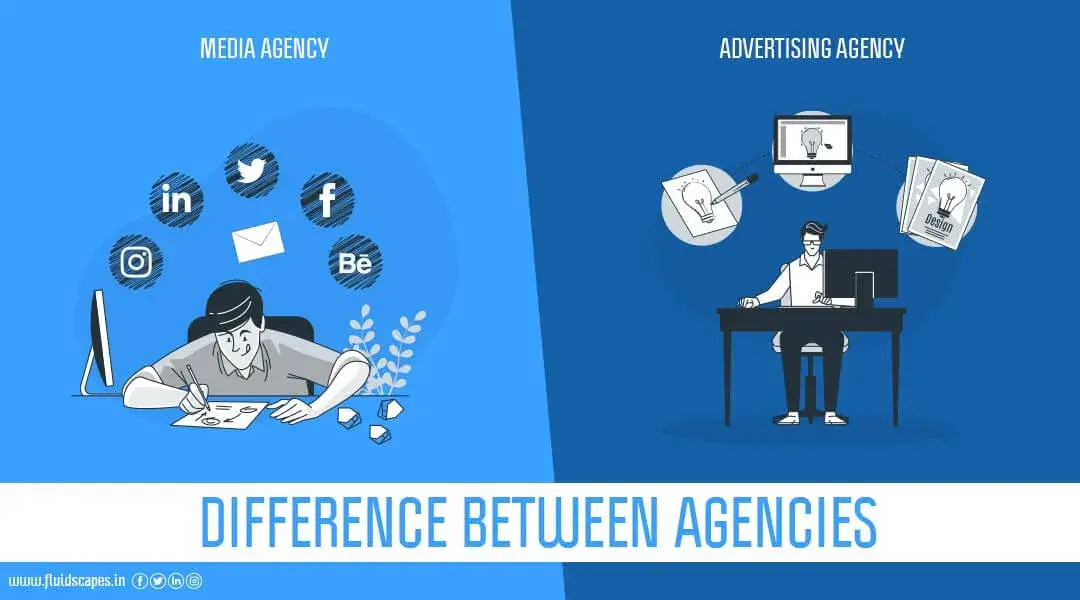
    In a nutshell, a media agency works with various media, channels, and marketing strategies to increase a client’s online and offline visibility. An advertising agency, on the other hand, is responsible for creating tailored advertising content for specific audiences.

    Their specific objectives bring forth the following differences between the media and advertising, such as:

    • Differences in purposes – If a client wants to advertise their brand, they are more likely to turn to advertising agencies. However, if they want to increase their sales, increase their market share, and develop their products, they should contact a digital marketing cum media agency.
    • Differences in approach – Advertising agencies create advertising content and broadcast them on various media channels as decided by the clients, whereas digital marketing cum media agencies conduct detailed customer and competitor surveys and analytics for a brand to develop strategies for advertising and media.
    • Differences in skill sets – People in the media agency typically have marketing and media background, whereas advertising people mostly have research and creative background.

    How important are the roles of media in advertising?

    Selecting the appropriate media channel is critical for targeted advertising. Only then can potentially interested parties be reached in a cost-effective manner. The below points should be ascertained before launching an advertising campaign:

    • Has the appropriate medium been chosen to reach the greatest number of people?
    • Is there enough data to specifically address the target group?
    • Is the communication’s language appropriate?

    Mass media advertising

    The mass media includes the Internet, television, radio, billboards, and other forms of mass communication that are accessible to a large proportion of the population, allowing advertising to have a significant impact.

    A mass media marketing campaign usually spans through multiple media channels. Companies must maintain consistent branding across all channels so that consumers begin to associate specific visual themes, colors, and concepts with the company’s products.

    Current trend

    Despite their differences, the media agencies and advertising agencies are being looked at as integral parts of digital marketing as a whole and thereby giving rise to inclusive services to the customers at more competitive price points.

    Source- Fluidscapes
    We are one of the best digital marketing companies in India that provides online reputation management services to all types of organizations. We assist businesses to stay on top of the game by leveraging the latest technologies and breakthroughs in marketing strategies and business processes. Want to grow your business, even more, get in touch with us and we’ll tell you how.