Author: admin

  • TOP 5 Domains of AI Insider Secret

    TOP 5 Domains of AI Insider Secret

    As AI continues to be among the most talked about subjects of modern times and will likely be the same in the coming years through continuous development, one might wonder what goes on inside the AI black box that produces such unbelievable outcomes. So, here is a quick look into the domains of AI to get an idea of how it works.

    The Domains of Artificial Intelligence

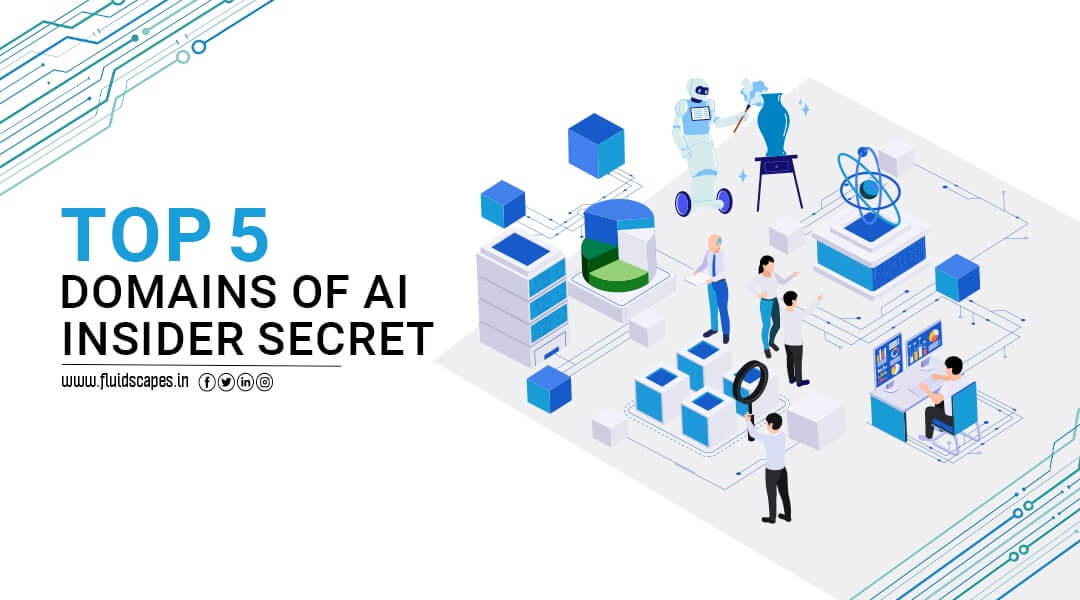
    AI is a multi-functional concept built around the model of the human brain. Therefore, it has (or strives to have) abilities to perform various forms of intelligence similar to those of the human brain. The multiple specialised sectors that make up the domains of AI are made up of intelligent machines and algorithms that mimic responses from the brain for a variety of requirements and applications. These domains are as follows:

    • Natural Language Processing
    • Computer Vision
    • Machine Learning
    • Deep Learning
    • Robotics

    Natural Language Processing (NLP)

    Natural Language Processing (NLP) is to make it possible for machines to comprehend, analyse, and produce human language.

    The goal of NLP is to eliminate communication barriers between people and machines, enabling natural interactions and deriving insightful information from textual input.

    Benefits of NLP

    • Speech Recognition: Speech recognition systems use NLP to convert spoken language into text. Voice assistants, voice-controlled devices, and dictation software all make use of this technology.
    • Language Translation: Another amazing application of NLP is language translation, which allows machines to translate text from one language to another. This app is useful for translation services, language learning apps, and global communication.

    Revolutionising applications of NLP

    • Virtual Assistants: Popular virtual assistants such as Siri, Alexa, and Google Assistant rely on NLP. These assistants comprehend spoken language, process user questions, and deliver appropriate responses or tasks based on the situation.
    • Chatbots: NLP is the backbone of chatbots because it allows them to have human-like discussions with users. These chatbots are used in customer service, assisting consumers in finding information and making personalised recommendations.

    Computer Vision

    Computer vision is a domain of artificial intelligence that allows computers and systems to extract meaningful information from digital photos, videos, and other visual inputs and then act or make recommendations based on that information. If artificial intelligence allows computers to think, computer vision allows them to see, watch, and comprehend.

    Computer vision functions similarly to human vision, with the exception that humans have an advantage. Human vision has the benefit of lifetimes of context to train how to discern objects apart, how far away they are, if they are moving, and if there is something wrong with a picture.

    Machine Learning

    Machine learning is a branch of artificial intelligence that allows computers to learn from data and improve their performance without the need for explicit programming.

    It is critical in AI because it provides algorithms and approaches that allow machines to recognize patterns, predict outcomes, and solve complex problems.

    Machine learning also enables the processing of massive volumes of data and gains significant insights that can be used to drive decision-making and automation. The computers are fed with high-quality data, which is processed by various algorithms to develop ML models to train the machines on this data. The algorithm used is determined by the type of data and the action that has to be automated.

    Many businesses, including healthcare, banking, and e-commerce, use machine learning. The following are some of the reasons why learning machine learning is essential:

    • Machine learning can be used to create intelligent systems that can make data-driven judgements and predictions. This can assist organisations in making better decisions, improving operations, and developing new goods and services.
    • Machine learning provides valuable tools for data analysis and visualisation. It enables you to uncover insights and patterns from massive databases to be used in understanding complex systems and making informed decisions.

    Deep Learning

    Deep learning is a machine learning technique that trains computers to do what people do instinctively: identify similarities or patterns. In deep learning, a computer model learns to execute categorization tasks directly from images, text, or sound.

    Deep learning models can attain cutting-edge accuracy, sometimes outperforming humans. Models are trained to utilise a vast quantity of labelled data and multi-layered neural network architectures.

    Most deep learning techniques employ neural networks, which is why deep learning models are frequently referred to as deep neural networks.

    Deep learning models are trained by vast amounts of labelled data and employ neural networks that learn features directly from the data, eliminating the need for manual feature extraction.

    Deep Learning application examples

    • Automatic car driving: Deep learning is being used to automatically detect things such as stop signs and traffic signals. Deep learning is also used to detect pedestrians, which helps reduce accidents.
    • Aerospace and defence: Deep learning is used to identify objects in satellite images.
    • Medical research: Deep learning is being used in cancer research to detect cancer cells automatically.
    • Industrial safety: Deep learning assists in the prevention of accidents in workplaces by automatically recognising when humans or objects are within a dangerous distance of machinery.
    • Electronics: Deep learning is utilised in automatic hearing and voice translation in electronics.

    Robotics

    Robotic technology powered by artificial intelligence takes automation to the next level, using robots to automate jobs or processes and reduce the use of manual labour. Automation can be utilised to increase productivity, improve quality, and lower costs. Automated systems can also contribute to increased safety and lower risks.

    Robotic automation can take many forms, ranging from simple systems that handle a single robot arm to very sophisticated software-driven solutions that manage hundreds of robots.

    The benefits of AI-powered robotics are:

    • Increased productivity
    • Reduced cost
    • Improved safety
    • Improved flexibility
    • Improved quality

    Conclusion:

    Artificial Intelligence (AI) is transforming our personal and professional worlds rapidly. AI is not a single technology but a combination of many technologies to create intelligent machines that can mimic human abilities, such as learning, reasoning, and problem-solving. The domains of AI signify the various faculties of the human brain that are responsible for various aspects of intelligence. There are a large number of fields (and counting) that have improved immensely with the use of AI. And many times, artificial intelligence has performed better than human intelligence.

    Source- Fluidscapes
    We are one of the best digital marketing companies in India that provides online reputation management services to all types of organizations. We assist businesses to stay on top of the game by leveraging the latest technologies and breakthroughs in marketing strategies and business processes. Want to grow your business, even more, get in touch with us and we’ll tell you how.
  • How an ORM Agency Can Help Protect and Enhance Your Online Reputation

    How an ORM Agency Can Help Protect and Enhance Your Online Reputation

    Your reputation is your best asset, for an individual or for a business. The question is how to grow and secure this asset at a time when negative reviews, ratings, or viral posts can damage it overnight. Brands are overwhelmingly turning to ORM agencies to create and maintain a halo of positive perception around their name, integrating online reputation management into their daily activities.

    What is Online Reputation Management or simply ORM?

    ORM is a broad term that aims to improve how the public sees a company, brand, or individual. Online reputation management involves a variety of activities, such as handling material, preventing and resolving problems that could harm a company’s overall market reputation, monitoring online reputation, and responding to customer complaints that damage their brand image.

    While a company’s reputation directly affects its market worth, ORM is essential to developing brand reliability. In a word, ORM assists firms in monitoring and upholding a favorable online reputation that boosts commercial profits.

    Why is it Critical for Businesses to Hire ORM Agencies?

    The majority of businesses struggle to maintain consumer loyalty. They continually work to create new features and products to fulfill their demands and have one-on-one interactions with them.

    But regardless of how much money businesses spend on customer support and product development, their reputation will occasionally suffer. Online reputation management begins to take effect whenever a dissatisfied client leaves a bad review or makes a vehement comment on social media.

    ORM companies can help you comprehend how customers view your company when they look for or encounter it online. To put it another way, they actively seek to understand what information users find online.

    This is crucial since 85% of consumers say they are as likely to believe internet evaluations from other customers as they are to believe personal recommendations from friends and family. Additionally, 49% of customers need at least a four-star rating from a company before they consider doing business with it.

    How ORM Functions

    The way your company is perceived online ultimately determines the chances of your success, whether your product and brand will be popular or you’ll have to struggle.

    ORM functions by circumventing the negative information with multiple types of positive content. For instance, the ORM agency might include more positive reviews if there were complaints about a product to guarantee that the reputation of the business as a whole was upheld.

    Another very effective strategy is to request pleased and satisfied customers for favorable reviews and a 5-star rating on Google. This affects a brand’s overall ranking.

    In addition, ORM services stress the use of both sponsored and earned media to disseminate material that further improves the brand reputation.

    What are the Concerns about your Reputation in the Digital Age?

    Now that you have some ideas about ORM and how it is used, let’s have a look at the concerns of having an online presence that must be handled professionally to save the reputation of your brand:

    1. Digital word-of-mouth.

    Most customers research products thoroughly before purchasing and are influenced by reviews and ratings as personal recommendations, which increases trust in a brand.

    However, many consumers would easily disregard five positive reviews but will change their minds if they encounter one negative review. Poor ratings are even more dangerous.

    2. You can’t delete a negative review.

    The best and worst thing about reviews and ratings is that they cannot be removed. You cannot erase reviews about your company, nor can you delete reviews about your competitors. You must guarantee that there are enough good reviews to balance out the negative ones and that your brand’s overall rating remains high.

    However, not every company considers negative feedback as an attack on their reputation; many use criticism from their customers to improve their services and product quality.

    Negative feedback can be very important in getting around the limitations and developing a fresh marketing approach.

    How the ORM Agencies Manage your Online Reputation

    Although many factors come into play, the final ORM strategy takes shape, based on the industry and its audiences. The following are some of the factors that ORM companies insist on helping secure a favourable online market reputation:

    • Having a sensible and interesting website—This helps you create your brand.
    • Having a web monitoring strategy that looks for negative reviews or comments about you online may include tools like Google Alerts. Other software can also be used for advanced filtering.
    • Social listening – this is the process of monitoring every mention of your name on social media using cutting-edge technology (AI-based tools) and social media experts. This technique can evaluate the worth of your brand while separating the unfavourable remarks and reviews to be handled professionally.
    • Using social media engineering – it may be possible to suppress embarrassing or insulting comments or negative press at the search engine level, if necessary. Otherwise, appropriate responses may be written back to reassure an unhappy customer. There are steps that may be performed to make sure that your public statement circumvents any negative news on Google when it is carried on the press channels. You can benefit from celebrity and influencer social media management as you work to establish your reputation.
    • Dealing with direct or indirect attacks – matured and professional responses to the issue should be posted. The goal would be to turn an adversary into an ally. Witty and modest responses backed by facts help win hearts. However, in some exceptional instances, proper legal action may be contemplated.

    Final Thoughts

    In the digital era, it’s absolutely important for corporations to manage their online reputation. Online reputation creates the right perception that you want your customers to have of you or your company, based on the reviews, comments, ratings, etc. that are publicly available metrics of online popularity.

    Employing a skilled OEM agency may prove to be essential for developing a positive internet reputation that will draw in new clients, increase trust and trustworthiness, and enhance your brand’s overall image.

    Source- Fluidscapes
    We are one of the best digital marketing companies in India that provides online reputation management services to all types of organizations. We assist businesses to stay on top of the game by leveraging the latest technologies and breakthroughs in marketing strategies and business processes. Want to grow your business, even more, get in touch with us and we’ll tell you how.
  • ORM Agency Vs. In-House Reputation Management: Which Is Right For You

    ORM Agency Vs. In-House Reputation Management: Which Is Right For You

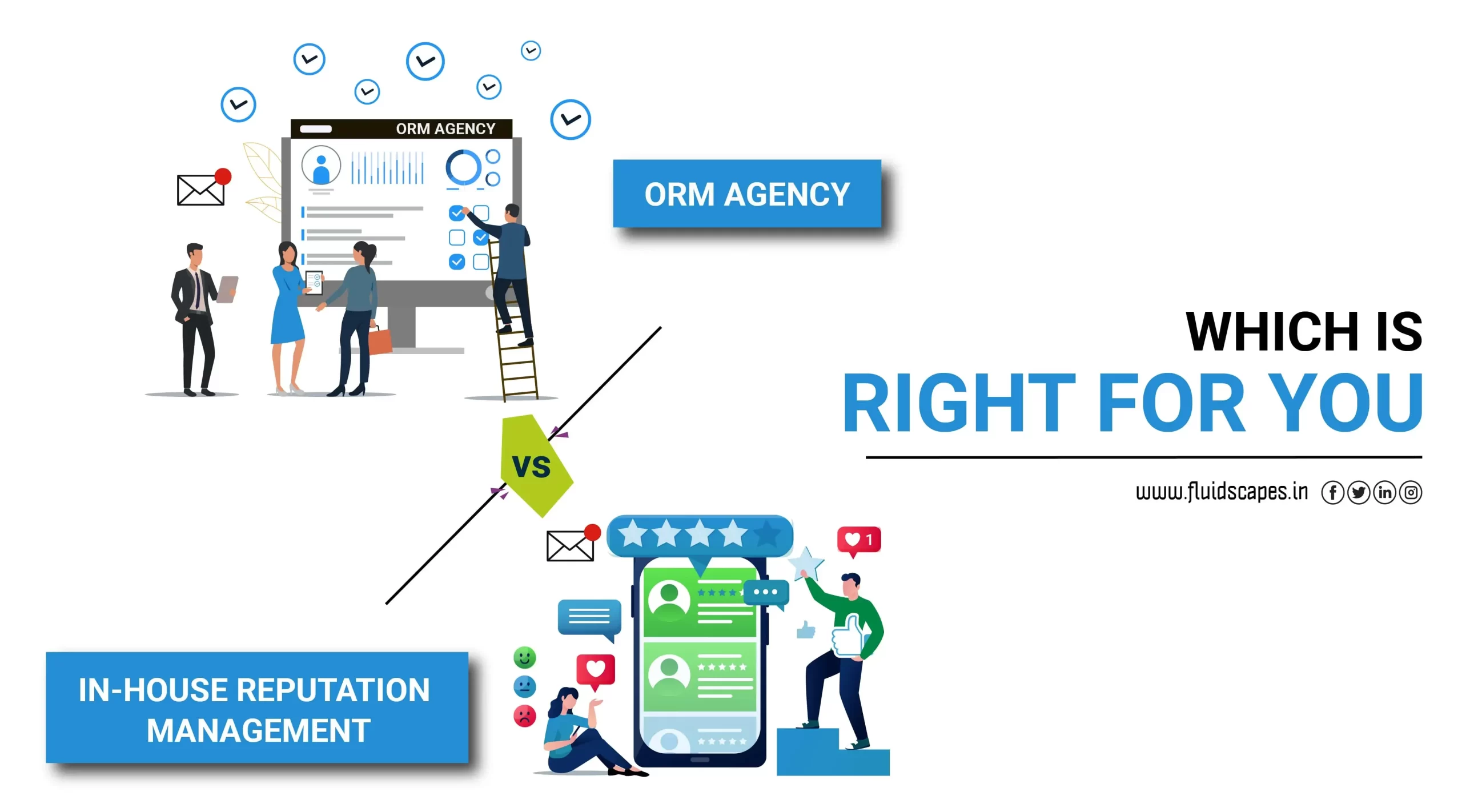
    While ORM (Online Reputation Management) is seen as the backbone of a business’s branding strategy, the decision of whether it should be done in-house or through an ORM agency often requires deliberation. Each has its pros and cons, which must be weighed against the policy, budget, and goals of the business to select the right option.

    In order to ensure your ORM strategy delivers, it requires knowledge, skills, and dedication. So hiring the right team of professionals holds the key to expanding and growing your business through cut-throat competition.

    Sometimes this involves hiring talents to build your in-house team. However, outsourcing the operation to an external ORM agency may also look practical, considering many angles. As a result, small business owners frequently ponder, ‘Should I outsource or hire?’

    The answer isn’t easy, but there are a few essential factors to consider when deciding whether to hire someone full-time or use a third-party service provider. Continue reading for a guide on in-house versus outsourced recruiting so you can make an informed decision about when to outsource and when to maintain duties within your team.

    Considerations for an in-house team

    It is critical to recognize that the online marketplace is an open platform where the past and present experiences with respect to your brand are reflected, some of which could be engineered by the competitor brands. Therefore, having the right crew who will understand, manage, and take your brand ahead of the competition is the bedrock for in-house ORM exercise.

    The dilemma here is whether to select a group of individuals with extensive brand knowledge but no expertise in relationship management, or to select a group of individuals who are leaders in that field but have little to no brand expertise.

    Before selecting any of the above, there are a few questions you must understand and answer in order to make the best decision:

    1. Does your organisation have enough digital marketing specialists, in terms of content writers, influencers, researchers, analysts, domain experts, and so on?

    2. If so, do these resources have adequate time to devote to ORM implementation, or they have to perform other tasks as well.

    3. Do you have the right tools and competent analysts to monitor your and your competitors’ online performance (24/7)?

    4. Do you have the channel experts who can manage mentions of old issues or discrepancies.

    If you have the necessary setup that can meet the above requirements, you can begin your in-house ORM operation. Following are the benefits and drawbacks of running ORM in-house:

    Advantage:

    1. You are broadening the skillset of your company by gaining further experience.

    2. By utilising in-house manpower for the process, you reduce the chances of errors because they are more familiar with the product, brand and the corporate policies on various matters.

    3. The insights gathered through online reputation management are not shared and remain only within your organization. This is qualitative and quantitative data that is critical for developing future initiatives.

    Disadvantage:

    1. Industry knowledge is only one side of the coin; setting up ORM in-houses requires business process expertise, which needs to be built from scratch. Hence, it requires more time and devotion by the management for the project to kick off.

    2. Setting up an ORM team is equivalent to introducing a new department in an organization, hence the decision of making processes needs to come from the top management; which can be a big hurdle.

    3. The process might turn out to be more time as well as resource consuming than estimated, because ORM is not just about human resource management but also technical implementation. For example, if you are planning to implement ORM as one of the focus areas of your company, it would require integration of multiple fields. Your company’s knowledge base, customer information base, etc. needs to be integrated with the software tools being used for the ORM operation; and integration could be complicated and time consuming!

    4. In terms of cost-effectiveness, outsourcing is more efficient, because ORM agencies can take care of all the overhead processes related to training and maintaining the project, which gets tedious in-house.

    5. It also runs the risk of earning huge losses, due to latency or lethargy in the process, as well as due to lack of proper planning.

    Considerations for ORM agency

    If your organisation lacks the necessary software tools and skills, it is better to outsource the job. Managing a brand online is a time-consuming effort, and doing so with absolute skill is essential. An external ORM company has a variety of expertise dealing with other clients, which can be utilized in reputation building for your brand. Let’s look at the advantages and disadvantages of outsourcing ORM.

    Advantages:

    1. The external ORM agency, if selected properly, brings to the table a ready set up, experience, and high-level expertise from working on reputation management for other companies. You can easily judge their performance by checking their clients’ reputations and customer engagement levels.

    2. Outsourcing your ORM services to an agency with competent team members and a good understanding of the domain means accountability for the result is assured from day 1.

    3. Outsourcing ORM ensures the smooth operation of the project and provides valuable insights to you. Professional handling of your brand is made possible through quick, controlled, and informative responses to the customers on social media, thus giving rise to higher customer engagement. This in turn results in customers’ delight and positive word-of-mouth suggestions that further lift the brand value.

    4. It is more cost-effective to get the ORM services done by an external agency rather than running it in-house. Besides the cost of office, equipment, and software, the high CTC of the employees accounts for high overhead for the operation.

    Disadvantages:

    1. Picking the right tone and style to match your brand voice could be a problem initially for an external ORM agency. Creating content and responses keeping in line with your corporate policy for customer handling, grievance redressals, etc. may have to be monitored and tutored in the beginning.

    2. Success of your ORM mission highly depends on the understanding and communication between the account manager of the agency and the brand’s point of contact. In case there is a snag, it could lead to uncertainty and lack of consistency.

    Conclusion

    The primary goal of Online Reputation Management, whether in-house or outsourced, is to learn what your consumers and prospects believe about your brand and improve it if required. Successful ORM is only achievable with the correct combination of technology, expertise, and hard work. While the decision of whether to have an in-house team or outsource the service to an external agency depends on budget allocation and other factors, you have clear-cut advantages and disadvantages of each to make an informed decision.

    Source- Fluidscapes
    We are one of the best digital marketing companies in India that provides online reputation management services to all types of organizations. We assist businesses to stay on top of the game by leveraging the latest technologies and breakthroughs in marketing strategies and business processes. Want to grow your business, even more, get in touch with us and we’ll tell you how.
  • Building Of A Successful Advertising Program: Tips & Strategies

    Building Of A Successful Advertising Program: Tips & Strategies

    A well-thought-out ad campaign can boost your business many fold. The advent of digital marketing has made advertising affordable, but you need to know what it takes to make your ads effective. This blog will help you as a guide to building an advertising program for the best results.

    Building an advertising program must be based on specific marketing objectives, such as acquiring new customers, increasing sales, creating awareness of new products or new locations, and so forth.

    Setting advertising objectives is not only necessary for marketing success but also for the day-to-day operations of a small business. Your immediate goal will decide your advertising objective and the response to your advertisement will be the metric to measure if your goal is reached.

    How to start building a successful ad program for your business

    An ad campaign involves lots of contemplation and deliberation. Follow the guidelines below to build the foundation for your ad campaigns.

    #1. Identify Your Goal

    What do you hope your advertising program will achieve? Are you attempting to draw in new clients or are you hoping to entice returning ones? What kind of consumer traffic growth are you seeking, and over what time frame? Each goal is unique and requires a specific design.

    #2. Make a budget

    Setting up a budget for your advertising strategy within your capacity is the next important point to consider. How much money are you willing to spend on your ad campaign? If you already have some ideas, how much will it cost to put them into action?

    #3. Identify Your Audience

    Identifying the demographics who are most likely to purchase your goods or service is helpful when you’re trying to increase sales. What group of people do you want to appeal to? Do you serve wealthy elderly or young people who scavenge cash from couch cushions?

    #4. Select The Products or Services to feature in your Ad Campaign

    It’s best if you can be as specific as possible. If you are a fast food chain, you’ll need to feature fast food in your advertising, rather than doing like a general eatery that has no specialty. Are you introducing a new product that you want to highlight in your ad, or do you want to spread the news of slashing the price of an existing product? What do you want to emphasize?

    #5. Conduct a thorough SWOT analysis

    SWOT is a complete assessment of your company that analyzes strengths, weaknesses, opportunities, and threats to your business. What is the main strength of your company? What do you excel in that gives you a benefit? Are you selling apparel? Then maybe you can take the opportunity of the ensuing winter to launch an ad for fashionable winter dresses. Also, stay informed about actions your rivals are taking that might harm your firm,

    #6. Articulate why you are different from the competition

    You should emphasize how your company differs from the competitors in your ad campaign. Use your SWOT analysis to identify why your product is better than the competition. It could be a lower price or superior quality, or something else. Utilize such differentiators in your advertising strategy.

    #7. Choose an advertising plan

    What, when, and where are the three questions that need to be addressed? What kind of advertisements will you be running? When will you start using them? Where will they eventually show up? Are you planning to use display advertisements on the web, Instagram ads, or Google ads? It all comes down to an effective marketing plan!

    #8. Look for a low-cost yet effective way

    The most effective kind of advertising is word of mouth, and few things can create word of mouth as effectively as a well-run social media campaign. What kind of social media marketing initiatives may your company run? Could you sponsor a nearby occasion or organize a competition of some kind? Make a list of inexpensive steps your company could take to assist your advertising strategy.

    #9. Craft your ad copy

    So you’ve determined your target audience, preferred platform, budget, and all other pertinent information. It’s now time to start writing great ad copy.

    Ad copy is the content that should be designed to achieve advertising goals. It should compel readers/viewers to take action.

    Do you want people to visit your store or your website? Is your immediate goal to drive free software signups or ebook downloads? Consider the content and how it can contribute to the end goal(s) of your ad campaign.

    #10. Make People Talk

    While your ad copy message should incorporate your brand’s purpose and tie in with long-term marketing objectives, it should also be memorable.

    This is why, as more advertising moves to social media platforms like Facebook, Instagram, and even Twitter, brand marketing must get to the point as soon as possible in order to generate customer attention and social sharing. If your message — whether it’s text, images, or videos — can compel consumers to pause, look, and share with their friends, you’ll have a lot higher chance of generating organic interaction and driving more traffic to your site.

    #11. Consistency across platforms is the key

    If no one follows through with an advertising plan, it won’t help to promote your firm. It is now time to put all of your thoughts into practice. Organize a social media campaign, play a podcast ad, and the like.

    The most important thing in ad campaigns is to maintain consistency irrespective of channels. Be consistent in your branding and messaging. Using the same logo and colors is very important. And the messaging on every platform must be consistent. Billboard copy should be identical to a social messaging copy, which should be identical to any radio or television advertisements, which should be identical to the homepage copy of your website.

    Final words

    Since the above steps lead to the success of your advertising program, you need to satisfy yourself with the results of each. For example, how sure are you about your target demographics, your strengths & weaknesses, your ad copy emphasizing your uniqueness, etc.

    Finally, analyzing the end result against your advertising objective(s) is essential. If it is the first of many advertising initiatives for your company, analyzing the results will help you improve on the next.

    Source- Fluidscapes
    We are one of the best digital marketing companies in India that provides online reputation management services to all types of organizations. We assist businesses to stay on top of the game by leveraging the latest technologies and breakthroughs in marketing strategies and business processes. Want to grow your business, even more, get in touch with us and we’ll tell you how.
  • How To Create A Successful Digital Marketing Campaign?

    How To Create A Successful Digital Marketing Campaign?

    The term, digital marketing, has become so commonplace today that many people look at it as just a set of tasks or routine activities. Mushrooming small agencies are offering the same bundled services for products A, B, and C, only to show some statistics to the clients but no palpable results. However, there are others who plan out their digital marketing campaign and execute the same to reap the maximum benefits.

    With big data and new innovations continually making digital marketing more powerful, more insightful, and more accurate, it is also making it a fiercely competitive field, given the increasing number of online platforms and the fleeting nature of audiences.

    Consumers and businesses are usually always online and on the go. And you need to track them and analyze their behavior to learn their choices, concerns, and where they spend their time. This and several other activities you’ll have to perform day in, day out in order to remain relevant in the ever-changing digital landscape.

    Without a product-specific strategy and progress monitoring routine, your digital marketing campaign will have very little chance to deliver. But how to make an effective strategy? We will tell you the fundamentals of an online campaign that yields results. Stay on..

    What is a Digital Marketing Campaign?

    A digital marketing campaign is a collection of online marketing tactics designed to increase your company’s online and/or offline visibility. Both paid and unpaid tactics may be used in a digital marketing campaign. Unpaid marketing methods are frequently referred to as ‘organic,’ whereas paid strategies entail some expenditure or investment.

    Compared to other marketing methods, digital marketing is very dynamic in nature as it responds promptly to a changed market scenario by publishing appropriate marketing content and garner huge engagement.

    A digital marketing campaign is a team work, and the important members of the team include:

    • Content writers that create messaging for organic content, email marketing, and paid media
    • Designers that develop wireframes and visuals
    • Web page developers
    • Digital marketing that push content on relevant social networks

    The commonly known digital marketing campaign examples include corporate rebranding, sales or promotions, and seasonal events, etc. Naturally, the types of digital marketing campaigns you use will be determined by your entire digital marketing strategy.

    How to build a winning strategy for your digital marketing campaign?

    Sticking to the basics always pays good dividends in any strategy. We have compiled here the

    7 basic steps for creating a digital marketing campaign.

    #1. Set a SMART Goal at the Start

    Without a well-defined goal from the start, no campaign can be effective. You need to set a smart goal(s), which is specific, measurable, achievable, realistic, and time-bound. For example, if your goal is to get more leads. it’s vague and doesn’t put a mark to reach. A more appropriate goal would be to ‘increase paid subscription conversion by 5% in Q4.’

    The campaign goal will determine the campaign’s duration, target demographic, and optimal channels to deploy.

    #2. Define your Target Audience

    Campaigns are an excellent way to zero down on specific parts of your target market. Your target market is made up of people who share similar characteristics, behaviours, interests, and values to your ideal buyer. For example, if you provide online financial services, your target audience could be MSME and startup owners or their finance heads

    With a campaign, you should begin with your overall target demographic and then drill down even deeper based on the specific goals of your campaign.

    For example, are you trying to attract new customers to this target market, motivate current clients to act, or bring back lapsed clients? If your campaign’s objective is to persuade current customers to upgrade, it can include a trial offer for advanced features or a temporary discount on the following subscription tier.

    #3. Select the Right Channels

    Since your goal is well-defined and you know your target audiences pretty well, the next step before you is to identify the right digital channels where you can reach your target customers. A variety of touchpoints, including web content, email, social media, and paid advertisements, are frequently used in effective digital marketing initiatives.

    To determine the channels you’ll concentrate on during your campaign, use your current understanding of your audience. If you’re unsure, conduct some research to fill in the blanks utilising site or social media statistics.

    Are there certain pages that your target audience visits more frequently than others? Offer a promotion there, perhaps. Do they favour Facebook and Instagram over Twitter and LinkedIn? Spend more time on social media in the channels that have more engagement.

    #4. Budget Your Campaign

    Any marketing campaign should take budget into account, first of all. Discussing financial requirements up front is the best policy for allocation of funds from the stakeholders who control the flow of funds.

    To create a workable plan that meets your budget, be sure to consider each and every expense that your digital marketing campaign might incur. The campaign budget also affects your paid advertising approach, such as the channels you choose to advertise on, the kinds of ads you run, and the duration of those ads.

    It also influences choices about resources. Examine whether hiring any outside designers, developers, or content writers will be necessary to complete the assignment on schedule. channels that get more interaction.

    #5. Create a Thorough Project Plan with Scheduling of Tasks

    A project plan will be your principal tool for communicating expectations and completing tasks. The more specific you are, the better!

    It’s better to divide your campaign into phases and then schedule the tasks and goals that must be met in each phase. Planning, content generation, and design are common tasks in the initial phases. Fine-tuning of the campaign work may be done from rhe respective channel itself. For example, your ’email’ channel may include tasks such as email creation, testing, and scheduling.

    Remember to check team availability as you schedule and assign work to ensure no one is overburdened with projects.

    #6. Coordinate with your Team to Get the Content for Your Digital Marketing

    Now that you are ready with your plan and schedule of tasks, it’s time to get to work on your campaign!

    The heart of any digital marketing campaign is the creation of content that engages your target audience through messaging and graphics. Consider which format(s) is most suited to each channel: For Twitter, video may be preferable, although plain-text content may be preferable for email.

    As you assess which format would resonate well with your audience in each channel, consider what worked or failed in previous campaigns.

    Your call to action (CTA) should be based on what are you expecting your target audience will do? Every campaign should elicit reactions from the audiences. So make sure your content provides a method for people to take the next step.

    #7. Track Your campaign status and adjust accordingly

    It is critical to track campaign progress and communicate with team members about deliverables. Also, make sure to track and analyse your marketing results on a regular basis so you can make modifications and optimise your campaign along the way. For example, if LinkedIn advertisements outperform Facebook ads, consider raising your LinkedIn expenditure while cutting your Facebook spend.

    Best advice to launch your first digital marketing campaign

    A digital marketing campaign requires long hours of engagement with skill, knowledge, labor, and prompt action. It makes better business sense and success probability to appoint a digital marketing campaign agency with a good track record and experience in campaigning for a similar product line as yours. This allows your business to gain a competitive edge without any marketing overhead.

    Source- Fluidscapes
    We are one of the best digital marketing companies in India that provides online reputation management services to all types of organizations. We assist businesses to stay on top of the game by leveraging the latest technologies and breakthroughs in marketing strategies and business processes. Want to grow your business, even more, get in touch with us and we’ll tell you how.
  • Benefits Of Migrating To Google Analytics 4

    Benefits Of Migrating To Google Analytics 4

    Google Analytics 4 or GA4 is a revolutionary update to the widely-used analytics platform, offering an event-based model that allows for more flexibility and improved insights. As the latest version of Google Analytics, GA4 is designed to provide marketers with enhanced data collection and reporting capabilities. Businesses are increasingly making the switch to Google Analytics 4 for its numerous benefits. In this comprehensive guide, we will explore the advantages of migrating to GA4, its key features and how to make the transition smoothly.

    Understanding Google Analytics 4

    GA4 is a significant departure from its predecessor, Universal Analytics. It introduces an event-based model that focuses on users and their interactions, rather than the traditional session-based approach. This shift enables marketers to gain a deeper understanding of user behaviour, as well as better predict future actions.

    The event-based model

    The event-based model in GA4 processes each user’s interaction as an individual event. This allows for a more comprehensive analysis of user behaviour by tracking various events, such as clicks, page views and conversions. With this model, marketers can delve into the intricacies of user interactions and better tailor their marketing strategies.

    Cross-platform analysis

    One of the major benefits of GA4 is its ability to track users across multiple platforms and devices. By consolidating data from websites, apps and other sources, GA4 provides a unified view of user actions, regardless of the platform or device used. This comprehensive view enables marketers to develop more effective, targeted campaigns.

    Enhanced pathing analysis

    GA4’s event-based model offers improved pathing analysis capabilities. By tracking user interactions in real-time, marketers can identify trends, patterns and potential bottlenecks in the user’s journey. This valuable information can be used to optimize website navigation, streamline the conversion process and ultimately, improve the user experience.

    Why Migrate to Google Analytics 4?

    Despite the steep learning curve associated with GA4, businesses should strongly consider migrating to this new platform. The benefits of GA4 far outweigh the challenges, providing marketers with more accurate data, enhanced insights and better decision-making capabilities.

    Improved data collection and analysis

    GA4 offers a host of new features that improve data collection and analysis. Machine learning and artificial intelligence capabilities enable GA4 to provide more accurate predictions and insights, helping businesses make more informed decisions. Additionally, GA4’s focus on user privacy ensures that data is collected and analyzed in compliance with current regulations.

    Future-proofing your analytics

    As Google continues to develop and improve GA4, it is clear that this platform is the future of analytics. Migrating to GA4 now will ensure that your business stays ahead of the curve, as well as give you access to the latest features and updates. Furthermore, it is important to note that new properties in Google Analytics now default to GA4, indicating that it is becoming the standard for analytics.

    Parallel data collection

    By setting up a GA4 property alongside your existing Universal Analytics property, you can collect data in parallel. This allows you to gradually transition to GA4 while still maintaining access to your Universal Analytics data. As you become more familiar with GA4, you can eventually phase out your reliance on Universal Analytics.

    Making the Switch to Google Analytics 4

    Migrating to GA4 is a relatively simple process that involves setting up a new GA4 property and configuring it to run alongside your existing Universal Analytics property. The following steps will guide you through the process of setting up GA4:

    • Log in to your Google Analytics account.
    • Click the ‘Admin’ gear icon located in the bottom left navigation.
    • Ensure the desired account and property are selected.
    • Click ‘GA4 Setup Assistant’ in the Property column.
    • Follow the on-screen prompts to create a new GA4 property.
    • If your site uses the gtag.js tag, enable data collection using your existing tags. If not, you may need to add the Analytics tag manually.

    Once the GA4 property is set up, you can begin collecting data in parallel with your Universal Analytics property. This will allow you to familiarize yourself with GA4’s features and capabilities while still having access to your existing data.

    Leveraging GA4 for Better Reporting

    GA4 offers numerous improvements in reporting, making it easier for marketers to extract valuable insights from their data. Some of the key reporting features in GA4 include:

    Real-time reports

    Real-time reports in GA4 display events that occurred within the past 30 minutes. This allows marketers to quickly confirm that the tracking code is working, monitor the immediate impact of marketing campaigns and observe user behaviour simultaneously.

    Life cycle reporting

    Life cycle reporting in GA4 mirrors the user journey through acquisition, engagement, monetization and retention. This type of reporting is ideal for analyzing how users enter the conversion funnel and how they behave once they are in the funnel. Life cycle reports can help marketers identify areas for improvement and optimize the user experience.

    Explorer reports and Analysis Hub

    GA4’s Analysis Hub gives marketers access to advanced analysis techniques and a template gallery. This powerful feature allows for more in-depth data exploration and visualization, providing personalized insights tailored to your specific business needs. Some of the available analysis techniques include:

    • Exploration
    • Funnel analysis
    • Path analysis
    • Segment overlap
    • Cohort analysis
    • User lifetime

    Conclusion

    Google Analytics 4 is a game-changer in the world of analytics, providing marketers with improved data collection, enhanced insights and better decision-making capabilities. Although migrating to GA4 may be challenging, the benefits far outweigh the challenges. By making the switch to GA4 with the help of marketing and branding experts of Fluidscapes, businesses can future-proof their analytics, stay ahead of the curve and ultimately, drive better results.

    Source- Fluidscapes
    We are one of the best digital marketing companies in India that provides online reputation management services to all types of organizations. We assist businesses to stay on top of the game by leveraging the latest technologies and breakthroughs in marketing strategies and business processes. Want to grow your business, even more, get in touch with us and we’ll tell you how.
  • Tips For Creating Effective Ad Copy And Landing Pages For PPC

    Tips For Creating Effective Ad Copy And Landing Pages For PPC

    While you expect your PPC ad to yield quick sales, it depends on how intelligent and effective your ad copy and the PPC landing page are. If the ad copy generates interest in the buyer to explore your offer, the landing page creates a compelling urge to go for it. This blog is going to tell you a few tips & tricks to make your PPC landing page high-converting.

    An effective PPC landing page can transform your marketing campaign into a revenue-generating machine, while a poor landing page can reduce the conversion rate.

    What is a Landing Page?

    A landing page is a web page created with the goal of converting visitors into leads or customers. It is usually unique from the rest of a website and is frequently visited via a pay-per-click (PPC) ad or an email campaign.

    A landing page’s primary objective is to entice visitors to complete a certain action, such as filling out a form or making a purchase. Landing pages are an important component of any internet marketing effort. You must construct a landing page if you want to increase PPC traffic.

    Also, because it allows you to record the visitor’s contact information, a landing page is an effective technique to create leads. You can then follow up with the lead and convert them into a customer.

    How Does the Landing Page Matter in Your PPC Ad Results?

    There are several advantages to using landing pages for paid search traffic, including:

    • Higher chance of conversions: A well-designed landing page can direct visitors to a specific action, such as filling out a form, boosting the likelihood of conversion.
    • Higher quality score: The relevance and quality of your landing pages influence the quality score of your PPC campaign. By optimizing your landing pages, you can raise your quality score and minimize your cost per click.
    • Improved tracking and analytics: By building distinct landing pages for each ad or keyword, you can track and analyze the effectiveness of your PPC campaign more accurately. This in effect allows you to make data-driven decisions and optimize your campaign for better results.

    Essentials of an Effective PPC Landing Page Design

    Your PPC landing page design can make or break your paid Ad prospect. Looking at some of the best PPC landing page examples, we’ve compiled the following necessary features of successful PPC landing pages:

    A Clear Call-to-Action (CTA) That Is Visible and Easy to Find: The CTA, whether ‘Sign Up Now’ or ‘Get Your Free Trial,’ should be appealing and pertinent to the ad.

    Customer Testimonials:

    Comments, reviews, and ratings from customers provide social proof. This contributes to the development of trust and credibility among potential customers.

    Catchy Headline and Subheading:

    A catchy headline and subheading that relate to the ad’s message. For example, if you’re promoting a new skincare product, your headline could be something like, ‘Discover Flawless Skin with Our Revolutionary Formula.’

    Contextual Imagery

    Visually appealing images enhance the message of the advertisement. If you’re promoting a vacation package, include photographs of the destination on your landing page.

    A Fast-Loading Landing Page:

    A quick website load speed is critical for keeping users engaged across all devices.

    Prospect Tracking

    At least one conversion point can be tracked, such as a form submission or purchase. This enables you to assess the effectiveness of your campaign and make data-driven decisions.

    When it comes to developing high-converting landing pages, remember that relevancy is everything. You can maximize the ROI of your paid advertising by aligning your messaging with your ad and focusing on a clear CTA.

    What Makes a Compelling Landing Page for PPC Design?

    1. Writing a Crisp Headline:

    Your headline should be interesting and catchy, and complement your ad copy that led them to your page. Assume you’re launching a PPC campaign to promote a new video game. Your landing page may include a heading that capitalizes on the excitement and anticipation around the release of the game, such as ‘Experience the Extreme Thrill With Our Epic New Video Game.’

    2. Ensure Message Matching:

    Message matching is a key factor in landing page design. Studies have found that increasing message matching can raise conversion rates by more than 200%. It can also cut your ad spent per conversion by 69%. That is a significant difference!

    To achieve a good message match, ensure that your meta tags include campaign keywords, that your headline in the first landing page section is related to your ad’s pitch, that your graphics are linked to your banner visual elements, and that your landing page has the same call to action (CTA) as your ad.

    3. Simplify Navigation for a Better User Experience:

    A landing page that is clean and tidy looks better and improves the user experience. Check that the product or offer promoted in the ad is easily accessible on the landing page. Consider removing distracting elements like menus and sidebars that may redirect attention away from the conversion funnel. Simple and straightforward navigation that allows users to quickly locate information about the game’s features, system requirements, and pricing.

    4. Use a Mobile Responsive Design:

    With mobile usage on the rise, using a mobile-responsive theme for your landing page design is critical to ensuring your ad caters to an increasing number of mobile users and looks fantastic on any screen. Test your page on a variety of devices to check that all features and content are fully functional and easy to use. Background imagery and color scheme are examples of design components that reflect the game’s graphics and style.

    5. Use the Proper Keywords to Target:

    When running a PPC campaign, you want to be certain that every click counts. That is why it is critical to make your keywords relevant to the landing page. Users are more likely to abandon your ad if they get on a landing page that is irrelevant to their search.

    Concentrate on message matching to ensure that your PPC landing page corresponds to the keywords. This means that your ad’s message should be similar to the message on your landing page. To create uniformity, use comparable language, colors, logos, copy, and offers.

    6. Use Video to Engage Your Audience:

    Incorporating videos relevant to your target demographics makes your PPC landing page stand out. A video, whether it’s a product presentation or an engaging ‘how-to’ film, may effectively promote your brand and turn more people into buyers. However, keep in mind that the video must be highly related to the landing page and offer. Otherwise, it may work against your conversion goals.

    7. Social Proof Can Help You Build Trust:

    Increase your audience’s trust and confidence by putting social proof on your landing page. Positive feedback, testimonials, and ratings from prior customers can increase your credibility and persuade new customers to act. Furthermore, displaying trust badges and security assurances can offer visitors peace of mind, particularly first-time buyers who may be apprehensive about purchase from an unfamiliar business.

    8. Simplify Your Lead Generation Forms:

    Keep your lead forms short and sweet to reduce friction in the conversion process. Asking for less information may result in poorer conversion rates, so only use the fields that are necessary. A simple form with fields for a visitor’s name and email address is an excellent place to start, but customize it to your company’s goals and needs. Remember, the goal is to make the conversion as simple as possible for visitors.

    9. Place CTA Buttons Intelligently:

    Call-to-action buttons positioned near the bottom or to the right of content outperform other places. Most importantly, never compel users to backtrack to find a CTA button – CTA buttons should show in appropriate places that correspond with a user’s experience.

    Final Point:

    A landing page’s effectiveness can be increased by data-driven insights. Experimenting with small or not-so-subtle adjustments to a landing page and conducting A/B testing can help you determine what works and what doesn’t. Changes to the landing page’s content, CTAs, headlines, or any other aspect may boost user engagement, lower bounce rates, and raise conversion rates.

    Source- Fluidscapes
    We are one of the best digital marketing companies in India that provides online reputation management services to all types of organizations. We assist businesses to stay on top of the game by leveraging the latest technologies and breakthroughs in marketing strategies and business processes. Want to grow your business, even more, get in touch with us and we’ll tell you how.
  • Using Social Media Analytics To Measure Marketing Success

    Using Social Media Analytics To Measure Marketing Success

    The advent of social media has been a tremendous boon for marketing and, at the same time, a big challenge too. While you have the opportunity to launch and establish your brand at a much cheaper cost, you have to work really hard to ensure your brand’s standing in social media. Continuous tracking and analyzing of the key metrics in social media marketing can only help your brand to remain afloat.

    What are Social Media Metrics?

    Social media metrics are the data that reflects the impact of your social media activities. They are basically the measures of the various parameters by which you can gauge the effectiveness of your social media campaign.

    Marketers frequently use social media analytics tools to monitor activity on social platforms, collect the metrics data pertaining to their target audience and region and analyze them to learn how a brand, product, or company-related topic is regarded.

    What Social Media Metrics Matter for User Engagement?

    There may be disagreement on which metrics are most beneficial for understanding the customer’s needs and desires. While the traditional user engagement indicators including clickthrough rates, time on page, content sharing, and comments are preferred by certain advertisers, other marketers track positive and negative audience sentiment using text analytics and search-based technologies.

    In both circumstances, gathering data is vital to document whether or not the time and effort invested in social media marketing is worthwhile and whether the company’s social media investment is paying off.

    What is Social Media Analytics and How Does it Help in Your Marketing Success?

    Social media analytics assist brands in determining crucial indicators such as reach, followers, engagement, clicks, and conversions. While many platforms include built-in insights, adopting a social media analytics tool can help you aggregate all of that data in one,user-friendly dashboard.

    Because social discourses produce divided views across many platforms, it creates a big hurdle for marketers in aggregating and consolidating them into a single, useful view. It makes another challenge for them to make the data useful and digestible for company executives, and to deal with privacy settings on social networking platforms such as Facebook and Twitter, which create hurdles and prohibit organizations from acquiring data. Dashboards in social media analytics tools make life easier for marketers.

    Social media analytics software analyses your data and recommends when, what, and how frequently you should post to maximise your results. Your optimal time to publish on Instagram is estimated based on your followers’ activity and prior posts.

    How Using a Social Media Analytics Tool can Boost Your Business?

    It is critical to invest in a platform that will provide you with greater insights about the performance of your social media campaign. It is incredibly difficult to understand your audience and establish a tailored plan if you post content without paying attention to its reach, engagement, and other analytics.

    Using a social media analytics tool ensures that you are continually developing and sharing material that is relevant to your target audience. You can learn things like:

    • How many people have seen your posts?
    • How frequently do users like or interact with your content?
    • What is the growth rate of your social media following?
    • How many sales and conversions are generated by your social media posts?

    And many more.

    Having these facts gives you a better idea of what material to post, when to publish it, and where to promote it so that your marketing plan isn’t just shouting into the void.

    What are the Social Media Performance Metrics?

    The most popular and crucial metrics to monitor are:

    Awareness

    This gives you a picture of how many people see your content and how much attention your brand gets. Reach, Impression, and the Audience Growth Rate are the main parameters to measure this metric.

    Engagement

    This shows how many people actually interact with your content, and not just see it. Likes, Shares, Comments, and Clicks are the main parameters that determine the Engagement Rate, Amplification Rate, and Virality Rate of your post.

    Customer Satisfaction (CSAT) Score

    Customer satisfaction metrics include more than just response times and response rates. CSAT (customer satisfaction score) is a number that indicates how satisfied customers are with your product or service.

    Net Promoter Score (NPS)

    NPS is a metric used to gauge client loyalty. Unlike CSAT, NPS is effective at forecasting future customer relationships. It is based only on the likelihood that you would tell a friend about our [company/product/service] if they asked you.

    Click Through Rate (CTR)

    The click-through rate, or CTR, is the frequency with which audiences click a link in your post to obtain extra content. This can range from a blog article to an online store. CTR indicates how many people saw your social material and desired to learn more. It’s an excellent indicator of how effectively your social material promotes your product.

    Conversion Rate

    Conversion rate indicates how frequently your social material initiates a conversion event such as a subscription, download, or sale. This is a critical social media marketing measure since it demonstrates the usefulness of your social content as a means of feeding your funnel.

    Social Share of Voice (SSoV)

    Social share of voice quantifies how many more people are mentioning your brand on social media than any of your rivals. How much of the social discourse in your sector is focused only on you? Mentions may either be:

    Tagged directly with (e.g., “@fluidscapes”)
    Untagged (indirect, like “fluidscapes”)

    SSoV is essentially an indicator of your brand’s market visibility and relevance.

    What are some Leading Social Media Analytics Tools in 2023?

    We have compiled here the top 10 social media analytics tools, some of which are free, some are paid:

    • Google Analytics
    • HootSuite
    • Sprout Special
    • Zoho Social
    • Buffer Analyze
    • Cyfe
    • BuzzSumo
    • Brand24
    • Keyhole
    • Brandwatch

    Using a tool will help you with all relevant data to reset your social media strategy all the way through your sales funnel and improve your ROI indicators such as conversions. Custom graphs and charts allow you to visually present your findings to stakeholders across the organization.

    Conclusion

    The success of your social media marketing greatly depends on how well you can track the key metrics across the platforms and analyze them. There are software tools available to help you with all the tasks and give you the right picture of your current standing and the required attention. However, as a marketer on social media, your basics should be clear. In this blog we have tried to address the basic questions that might come to your mind when deciding your strategy.

    Source- Fluidscapes
    We are one of the best digital marketing companies in India that provides online reputation management services to all types of organizations. We assist businesses to stay on top of the game by leveraging the latest technologies and breakthroughs in marketing strategies and business processes. Want to grow your business, even more, get in touch with us and we’ll tell you how.

  • Top AI Tools For Digital Marketing Success

    Top AI Tools For Digital Marketing Success

    AI is a giant leap in science and technology, which is redefining the standards in almost every field. One of the fields that have made the most of it is digital marketing. With AI in digital marketing, it’s not only a tremendous boost in efficiency but the emergence of new techniques. This blog will highlight some leading AI tools for digital marketing, but before that, let’s take a brief tour of AI-powered digital marketing tools.

    What Exactly is an AI-Enabled Marketing Tool?

    The use of AI or artificial intelligence in any function appends its intelligence and multiplies its efficiency. AI marketing adds power to marketers to get insights into their customers and create better content. AI-guided marketing assets are personalized and optimized for the consumer journey. Chatbots, tailored advertising, and content generation are examples of this.

    The AI will typically collect data, learn client behaviors, and analyze this information to assist a firm in meeting its objectives. AI can even contact clients who perform a specific action on your website, such as clicking a button or liking social media posts.

    There is a variety of AI software that marketers may employ to perform the desired automated functions. AI marketing is utilized for a variety of purposes, including data analysis, media procurement, content creation, personalization, and more. Let’s look at how marketers use AI now.

    How do Marketers use AI?

    While broadly the use of AI in marketing is in content personalization, predictive analytics for customer insights, and targeting decisions, below are the specific fields where marketers are increasingly using AI:.

    • Content personalization
    • Data analytics
    • Content generation
    • Media buying
    • Chatbots
    • Email marketing
    • Sales forecasting
    • To improve customer experience
    • SEO

    What are the Benefits of AI-Powered Marketing Tools?

    It takes a lot of effort to persuade potential customers to choose your products or services when you run a business in a competitive industry. And, as your company grows, you’ll have to devote a significant amount of time and effort to analyzing large amounts of data in order to give the greatest possible experience to everyone who interacts with your firm. Throughout this long journey, AI marketing tools can benefit your company in a variety of ways, such as:

    Your decisions will be correct and faster

    You may automate the process of making data-driven judgments with the use of artificial intelligence and machine-learning models. Furthermore, data is necessary for producing high-quality work in every area of digital marketing. Your social media management and email marketing activities can be more precise with the help of AI marketing automation solutions.

    It will save you a lot of time and money

    Although you’ll need to set aside some of your cash to get the best AI tools for digital marketing, once you start using them, you’ll find that they save you a tonne of time and money. Artificial intelligence can complete some tasks more quickly and accurately than your employees could. And AI solutions can assist your internal staff in automating tedious processes so they can concentrate on the most crucial ones. Not to mention that it will aid in reducing the number of errors that your staff members commit.

    It will provide you with relevant consumer data

    Some AI solutions can assist you in predicting consumer behaviors through the analysis of your customer data, enabling you to deliver the most engaging content to every user. You’ll be able to suggest blog content, goods, or services with accuracy. That will enhance the customer experience and assist you in creating favorable associations with your brand.

    LEADING AI MARKETING TOOLS IN 2023

    #1. 10Web’s AI Website Builder

    Build or recreate a website in a matter of minutes, with the aid of artificial intelligence. 10Web’s AI Website Builder enables you to quickly create, design, and publish a professional custom website. Answer a few straightforward questions about your company, let AI create text and graphics that are specifically customized to your responses, fully customize your website, add more pages, and finish your website.

    #2. Ortto

    This AI tool helps you with customer segmentation. Achieve quick growth with Ortto, by making sure your customer data, messaging, and analytics are working together. It arms you with ungated access to complete, real-time customer data, sieve it using personal messaging and other filters, use advanced analytics to gain insights into the customer lifecycle, to optimize your current campaign and spot new opportunities.

    #3. Manychat

    Manychat helps you to forge automated interactive chats and SMS with prospects in Instagram Direct Messages and Facebook Messenger. This type of personalized conversation helps immensely in brand recognition, boosting sales, and providing customer support.

    #4.Phrasee

    Phrasee is a deep learning program powered by AI that allows you to optimize your brand language and create a better copy. Phrasee generates marketing messages using generative AI across the digital consumer experience. Marketers can use content testing and optimization to improve performance, conversions, and ROI.

    #5. Grammerly

    Grammarly is an intelligent proofreading tool that checks your grammar and spelling to help you generate more professional content.

    #6. Emplifi

    Emplifi is an easy-to-use interface for finding, scheduling, and sharing compelling content across all main social media networks. With AI-powered automation (including GPT-3 compatibility), it improves publishing efficiency.

    Emplifi lets you make better decisions faster with real-time data, improves brand authenticity with best-in-class UGC tools, and unifies your teams with streamlined workflows.

    #7. WebEngage

    WebEngage is an AI-powered email marketing platform that analyses your customers’ behavior to find the ideal timing and frequency to send them emails. It enables you to send relevant content and personalize each email based on your users’ details, preferences, and behavior, resulting in higher open and click through rates on your email campaigns from the start.

    #8. Tidio

    Tidio AI is a set of tools and capabilities that allow you to use artificial intelligence to automate customer care, increase conversion rates, and enhance overall productivity. It also helps your customer service personnel provide exceptional experiences, increase sales, and increase client happiness with your brand.

    Tidio consumers will be able to obtain AI technology for their businesses at a fraction of the cost given by other market providers.

    #9. Storydoc

    Storydoc is a tool for creating interactive AI presentations for corporations. When preparing any form of business presentation, Storydoc’s AI does the heavy lifting for you, allowing you to enhance lead engagement and conversions. It may be used to generate excellent sales and marketing collateral with no design skills required.

    Source- Fluidscapes
    We are one of the best digital marketing companies in India that provides online reputation management services to all types of organizations. We assist businesses to stay on top of the game by leveraging the latest technologies and breakthroughs in marketing strategies and business processes. Want to grow your business, even more, get in touch with us and we’ll tell you how.

  • Earn And Burn Loyalty : A Guide To Increase Customer Retention Rate

    Earn And Burn Loyalty : A Guide To Increase Customer Retention Rate

    In a marketplace where competition is hyper and the environment is ever-changing, the biggest marketing challenge faced by any brand is customer loyalty. Companies brainstorm for new ways to lure customers, but nothing works as much as the earn-and-burn loyalty strategy does.

    An effective loyalty program is critical for customer retention, and customer retention is critical for your business. Here is why

    • The cost of recruiting new consumers is significantly higher than the cost of retaining existing customers. A just 5% increase in client retention can result in up to a 95% increase in profitability. Acquiring new customers might cost anywhere from 5 to 25 times more than keeping those you already have.
    • Customers who have returned might become brand ambassadors, engaging in UGC posting or word-of-mouth communication about your product/service.

    What is a loyalty program?

    A loyalty program is one that systematically rewards customers for their loyalty by providing both real and intangible benefits such as discounts, additional services, unique access, and other incentives.

    A loyalty program cannot offer indiscriminate discounts or incentivize loyalty card ownership. It’s a data-driven program that rewards the appropriate clients for the expected behavior. But a loyalty program is not a cost center. At the end of the day, spending through loyalty programs must generate profits.

    What are the different types of Earn and Burn loyalty programs?

    • Earn and Burn
    • Tiered
    • Perks based
    • Communities based
    • Coalition of brands
    • Gamified

    Of so many types of loyalty programs, the Earn and Burn method is the simplest and most effective strategy.

    So, no wonder that a major part of your marketing efforts revolves around devising loyalty programs for customer retention, and you want to go with the earn-and-burn loyalty strategy.

    Earn and Burn Loyalty: What Is It and how does It work?

    Earn and burn loyalty programs commonly come to your mind when you discuss loyalty programs in general. It is the most basic yet successful loyalty tactic. Customers earn or gain points by participating in brand-assigned activities and then burn or redeem those points for discounts, awards, or incentives.

    This is a simple yet convenient concept that goes well with the customers’ psychology. Customers all across the world accept the earn and burn loyalty program because they understand, and trust this.

    The concept of ‘earning and saving points for later’ is one that most people believe in because it is dependable, proven, and tested. Earning and burning loyalty can also provide comfort to seasoned or repeat shoppers. It gives consumers the incentive to spend more in order to win later through loyalty redemptions.

    How can one gain earn and burn rewards?

    You can reward customers based on their spending with an earn-and-burn point-based loyalty program. Every rupee spent by the customer earns them the earn and burn reward points, which can later be redeemed as rupees towards a purchase. Digital wallet services, such as Google Pay, Amazon Pay, and others are examples of the wild successes of the earn-and-burn loyalty program.

    Why is the earn and burn loyalty program so popular?

    Quick implementation

    Earn & Burn loyalty programmes treat all consumers similarly, eliminating the need for additional segmentation. Implementation is quick and easy when just purchases are rewarded.

    Budget-friendly and convenient

    Earn & Burn programmes are simple to implement because the rate of reward redemption is restricted by the amount of loyalty currency available. Furthermore, it is less expensive than a discount system.

    High perceived worth

    Customers regard these programmes as excellent value, despite the fact that the incentive has a larger perceived value than its real cost. Furthermore, unspent points enable brands to save money.

    Simpleness of use

    The rule for earn & burn is simple: accumulate cash and redeem it. Customers may immediately comprehend the concept and begin earning points as a result of its simplicity.

    Creates Customer database

    Customers must identify themselves, either by joining up or by displaying their loyalty card, as both online and in-store transactions are rewarded.

    How to make your earn and burn loyalty program successful?

    Here are some practical and relevant ideas you may consider.

    Educate Your Customers

    Create a loyalty program with an earn vs. burn ratio that makes customers feel special and favored. Small customization can go a long way toward increasing customer loyalty to a company. Allow your clients to select their rewards from your catalog and create a dynamic program that revolves around them.

    Provide Multiple Ways to Earn Points

    Your company’s and marketing goals may not be one-dimensional, and neither should your loyalty program. Provide more than one way to gain points based on your marketing strategy. For instance, if you want to increase customer acquisition, reward your referrers. Similarly, with the assistance of a knowledgeable loyal partner, you may achieve your business objectives through your loyalty program.

    Collaborate with Charitable Organisations

    Collaboration with a charity can assist you in projecting a socially responsible image. Allow your customers to participate as well by providing a loyalty program. Allow clients to give their loyalty points to a worthy cause or charity. This will not only produce a ‘feel-good’ aspect, but will also build your relationships with your customers.

    Collaborate with Other Brands

    Even if you face a financial constraint, you can still maintain your rewarding options. Collaborate with other businesses to provide your consumers with a broader range of rewards to pick from and expand their scope of loyalty redemption. A joint program can benefit both parties while also making customers happy.

    Reward Social Sharing

    Creating a strong social media presence, while necessary, may be a daunting task. You can build both real user-generated content and a strong online presence with the support of your loyalty programs. Reward your customers for sharing your posts or leaving reviews and comments. Organic promotions will draw attention to the brand.

    Design gamified rewards

    Another effective method to reward customers is to provide them with great experiences. Your incentives may not always have to be monetary. You could design aspirational or experiential incentives.

    Experiential Rewards are incentives that are utilised to generate lasting memories with experiences such as concerts, events, cultural activities, and more to please customers and promote brand.

    Source- Fluidscapes
    We are one of the best digital marketing companies in India that provides online reputation management services to all types of organizations. We assist businesses to stay on top of the game by leveraging the latest technologies and breakthroughs in marketing strategies and business processes. Want to grow your business, even more, get in touch with us and we’ll tell you how.